Laser Rangefinder for Measuring Distances

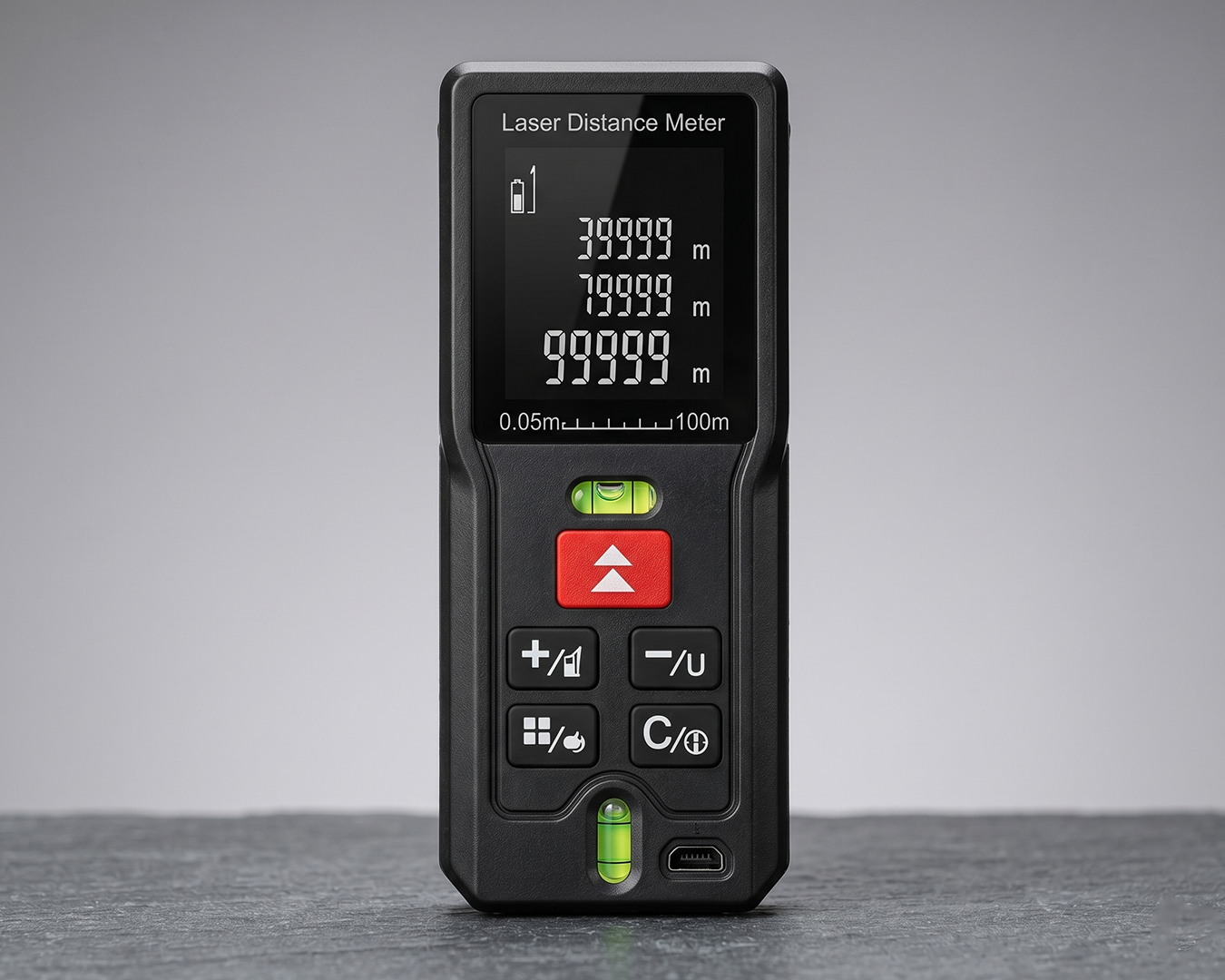
A handheld laser rangefinder for the school geography classroom and other science classrooms, used to measure the length, width and height of a room accurately. One K-12 learner takes the measurement alone, reads the result on the LCD and can recall stored values for comparison.

Thank you! Your submission has been received!
Oops! Something went wrong while submitting the form.

Specification

icon plus
  • Type: laser rangefinder
  • Measuring range: 40 m
  • Measuring accuracy: ±2 mm
  • Units of measurement: metres, inches, feet
  • Laser safety class: 2 (II)
  • Laser radiation wavelength: 620–690 nm
  • Laser radiation power: below 1 mW
  • Display: liquid crystal (LCD)
  • Result memory: 99 values, recallable to the display
  • Power supply: 2 AA cells, 1.5 V (not included in the delivery set)
  • Overall dimensions: 110 × 48 × 25 mm
  • Housing: durable plastic

Product passport: ULABS-G008 (PDF)

Additional info

icon plus

Use

  • The distance is determined by a laser beam directed at the target and by the signal reflected from it, so one person performs the measurement without a partner and without stretching a tape.
  • Preparation: install two AA 1.5 V cells observing the polarity, switch the unit on and select the units of measurement before starting a series of measurements, not in the middle of it. Room dimensions are measured in metres.
  • Establish the reference surface: measure a known distance and compare the readings, then always place the instrument against the reference point with the same surface — otherwise the 110 mm length of the housing is added to or subtracted from every result.
  • Direct the beam perpendicular to the target and hold the instrument still with both hands or place it on a firm support. With an oblique aim the device shows the distance along the beam, which is always greater than the distance between the planes.
  • Repeat each measurement two or three times: a spread within the ±2 mm accuracy of the instrument means the measurement was made correctly.
  • A matte light surface reflects the beam best; on dark, glossy, transparent and mesh surfaces the signal is weak, and a sheet of white paper or card is placed at the target instead.
  • Room dimensions are measured in sequence: length from wall to wall at about one metre above the floor, width from the same point, height with the instrument standing on the floor and the beam directed at the ceiling. Keep furniture, cabinets and people out of the beam path.
  • The memory holds 99 measured values and recalls them to the display. It is a sequence of numbers without explanations, so keep a measurement log in parallel and clear the memory before a new series.
  • Dusty air, bright sunlight on the target and discharged cells reduce the working range; a device brought in from the cold is left to stand until the condensation is gone.

Laser safety

  • Intended for general secondary education, for learners aged 10 and over (grade 5 and above), under the supervision of a teacher.
  • Do not look into the laser beam and do not direct it at people or animals even for a moment: the beam of a class 2 laser is hazardous to the eyes.
  • Do not direct the beam at mirrors, glass, polished metals or other shiny surfaces — the reflected beam changes direction unpredictably.
  • Do not examine the laser spot through a magnifier, binoculars, a microscope eyepiece or any other optical instrument: the optics concentrate the radiation.
  • Before first use, check the laser class, wavelength and power against the marking on the housing and follow the manufacturer's warning label.
  • Switch the beam on only at the moment of aiming at the target; do not keep the measurement button pressed unnecessarily.
  • Do not disassemble the housing and do not attempt to adjust the optical unit: with a damaged housing the radiation leaves in an unpredictable direction and work with the device is prohibited.

Battery safety

  • Use only cells of the type and rating stated in the documentation or on the housing; do not mix new and partly discharged cells.
  • Observe the polarity when installing the cells; if electrolyte leakage appears, remove them immediately without touching the contents by hand.
  • Remove the cells if the device will not be used for more than a month.
  • Do not recharge cells that are not intended for recharging and do not throw them into fire.

Maintenance and storage

  • Clean the emitter and receiver windows with a soft dry optical wipe, slightly moistened if needed. Solvents, alcohol and abrasives are not used. Wipe the housing and display with a soft damp cloth.
  • Protect the device from drops and impacts: an impact shifts the mutual position of the emitter and the receiver, after which the device gives a systematic error noticeably larger than ±2 mm. After every drop the accuracy is checked against a known distance.
  • Replace both cells at the same time and remove them before a long break in work.
  • Store in a dry heated room, in a case or box, away from heavy objects; do not leave the device in the sun, on a windowsill or in a car.
  • Storage conditions: temperature +5 °C to +40 °C, relative humidity 60 %.

Compliance

  • Complies with the applicable European Union directives and regulations and bears the corresponding CE and WEEE markings. Remove the cells before disposal and hand the device over to a separate collection point for waste electrical and electronic equipment.

icon plus
How long is the MIKKO Course?
Is the MIKKO Course good for new teachers
How long is the MIKKO Course?
Ask something?
More information

More information

Related products
view all

What our clients are saying about us.
view all

Customer testimonials

What our clients are saying about us.

Working with UNOWA was a turning point for our university. Their expert-led training in ABA, ADOS-2 and MIKKO reshaped how we think, teach, and prepare inclusive educators. The model inclusion classroom they equipped has become a living lab, a space where theory becomes hands-on skill. This partnership didn’t just support a project. It laid the foundation for a more humane, modern and inclusive education system in Kazakhstan.
Yerkin Zhumankulova
Vice-Rector in Academic Affairs. Kazakh National Women's Teacher Training University
Thanks to UNOWA’s innovative approach and professional guidance, we’ve redefined how we prepare future educators. The MIKKO training and inclusion lab brought international best practices to our university, not just as theory, but as living, hands-on tools that inspire confidence and real change.
Irina Rovnyakova
Vice-Rector for Strategic Development and International Relations. Sarsen Amanzholov East Kazakhstan University
Working with the UNOWA team was a valuable and supportive experience in delivering psychological and educational projects. Their reliable platform, openness to dialogue, and continuous technical support allowed me to focus on the quality and meaning of education. I confidently recommend UNOWA as a trusted partner for the development of psychological education and human-centered support.
Liudmyla Lahuta
President of the International Institute of Psychological Maturity INC
Thanks to our partnership with UNOWA, even schools in Armenia’s most remote regions now have access to fully equipped science and technology labs. Nearly half of the country’s schools have been modernized, bringing equal learning conditions to every student, no matter where they live.
Zhanna Andreasyan
Minister of Education, Science, Culture and Sport. The Government of the Republic of Armenia
UNOWA's national project equipped 14 Kazakhstan universities with inclusive classrooms to a unified standard. They delivered top-quality kits, equipment, digital courses with 24/7 access, and localized resources. This game-changer strengthened inclusive education foundations nationwide.
Dastan Yessenov
Coordinator of the PIU of World Bank in the Republic of Kazakhstan
UNOWA's national-level ABA and ADOS-2 training became a milestone for Kazakhstan's education system. The program was comprehensive, well-structured, and perfectly aligned with inclusive education modernization goals nationwide. I appreciated the balance of deep theory, practical sessions, and 24/7 online access. This strengthened specialists' ABA and diagnostics skills, directly improving support for children with special needs.
Karlygash Zholdassova
Inclusion Education Specialist of PIU of World Bank in the Republic of Kazakhstan
icon arrow left
icon arrow right

Customer testimonials

What our clients are saying about us.

UNOWA's national project equipped 14 Kazakhstan universities with inclusive classrooms to a unified standard. They delivered top-quality kits, equipment, digital courses with 24/7 access, and localized resources. This game-changer strengthened inclusive education foundations nationwide.
Dastan Yessenov
Coordinator of the PIU of World Bank in the Republic of Kazakhstan
UNOWA's national-level ABA and ADOS-2 training became a milestone for Kazakhstan's education system. The program was comprehensive, well-structured, and perfectly aligned with inclusive education modernization goals nationwide. I appreciated the balance of deep theory, practical sessions, and 24/7 online access. This strengthened specialists' ABA and diagnostics skills, directly improving support for children with special needs.
Karlygash Zholdassova
Inclusion Education Specialist of PIU of World Bank in the Republic of Kazakhstan
Working with the UNOWA team was a valuable and supportive experience in delivering psychological and educational projects. Their reliable platform, openness to dialogue, and continuous technical support allowed me to focus on the quality and meaning of education. I confidently recommend UNOWA as a trusted partner for the development of psychological education and human-centered support.
Liudmyla Lahuta
President of the International Institute of Psychological Maturity INC
Thanks to our partnership with UNOWA, even schools in Armenia’s most remote regions now have access to fully equipped science and technology labs. Nearly half of the country’s schools have been modernized, bringing equal learning conditions to every student, no matter where they live.
Zhanna Andreasyan
Minister of Education, Science, Culture and Sport. The Government of the Republic of Armenia
Thanks to UNOWA’s innovative approach and professional guidance, we’ve redefined how we prepare future educators. The MIKKO training and inclusion lab brought international best practices to our university, not just as theory, but as living, hands-on tools that inspire confidence and real change.
Irina Rovnyakova
Vice-Rector for Strategic Development and International Relations Sarsen Amanzholov East Kazakhstan University
Working with UNOWA was a turning point for our university. Their expert-led training in ABA, ADOS-2 and MIKKO reshaped how we think, teach, and prepare inclusive educators. The model inclusion classroom they equipped has become a living lab, a space where theory becomes hands-on skill. This partnership didn’t just support a project. It laid the foundation for a more humane, modern and inclusive education system in Kazakhstan.
Yerkin Zhumankulova
Vice-Rector in Academic Affairs Kazakh National Women's Teacher Training University
icon arrow left
icon arrow right
Laser Rangefinder for Measuring Distances
Speak to expertimage of finger pointing to a graph