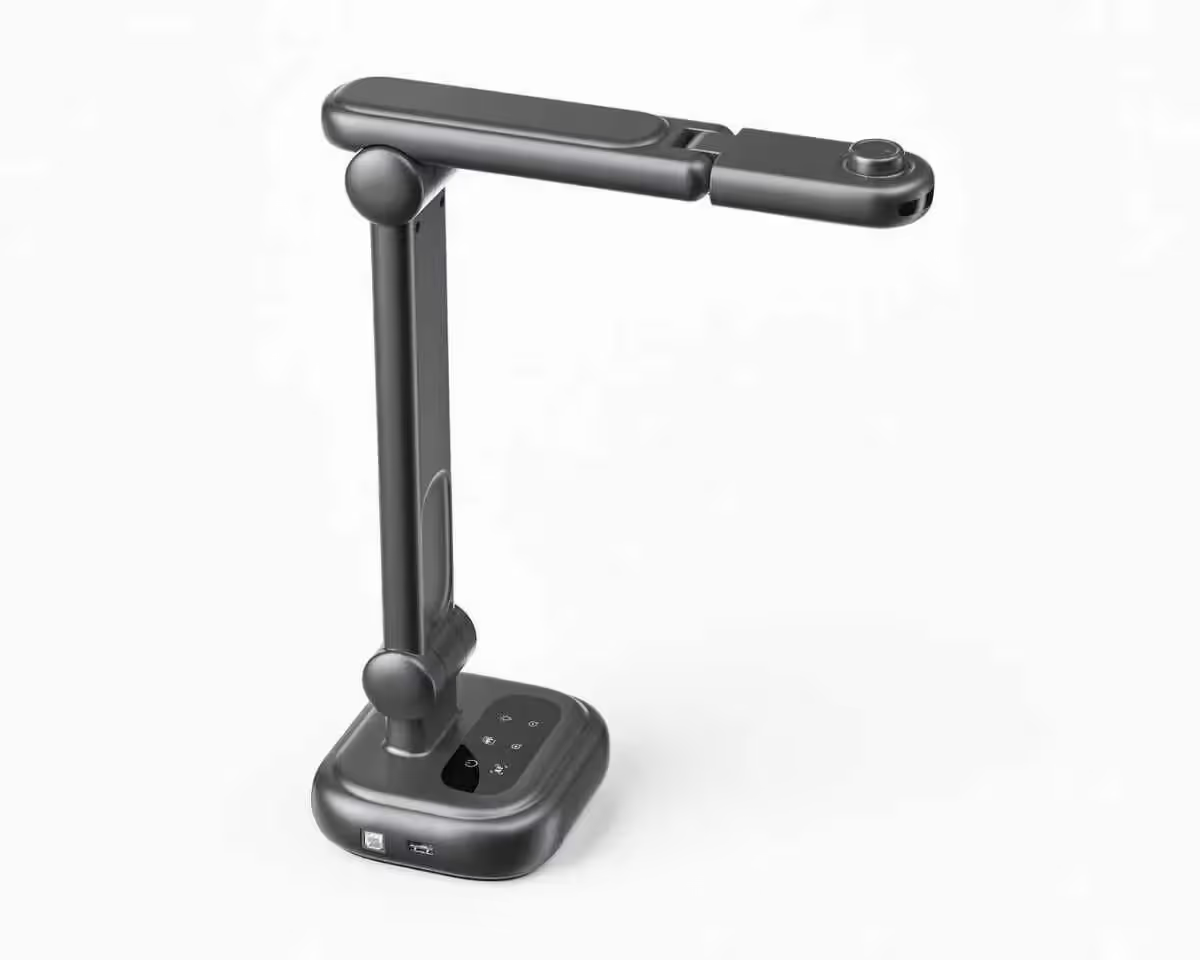
Educational 3D Printer with Enclosed Housing

An enclosed FDM 3D printer for school technology rooms and STEM laboratories, where K-12 students turn their own digital 3D models into physical objects. It is used in lessons on the basics of 3D modelling, prototyping and additive technologies, and comes with filament, software and methodological materials.

Thank you! Your submission has been received!
Oops! Something went wrong while submitting the form.

Specification

icon plus
  • Printing technology: fused deposition modelling of polymer filament (FDM)
  • Build area: 220 x 220 x 250 mm
  • Nozzle diameter: 0.4 mm
  • Maximum extruder operating temperature: 330 °C
  • Layer resolution: 0.05 mm
  • Print speed: 600 mm/s
  • Supported file formats: STL, OBJ, gcode
  • Print materials: 1.75 mm filament — PLA, TPU, ABS, carbon fibre, nylon and nylon with carbon fibre
  • Display: capacitive touchscreen, 4.5 in diagonal
  • Data transfer: USB cable, Wi-Fi wireless network
  • Housing: enclosed, with a built-in air filtration system
  • Power supply: AC mains, 220 V, 50 Hz
  • Overall dimensions: 402 x 420 x 543 mm

Kit Contents:

  • 3D printer with enclosed housing, air filtration system and 4.5 in capacitive touchscreen — 1 pc
  • Nozzle, 0.4 mm diameter, installed in the extruder — 1 pc
  • PLA filament for printing, 1.75 mm diameter — 10 spools, 10 kg total
  • Power cable and USB cable for connection to a computer — 1 set
  • Software for preparing models for printing: accepts STL and OBJ files, generates the control program in gcode format and transfers it to the printer over the USB cable or a Wi-Fi wireless network
  • Methodological materials for use in the educational process — 1 set
  • Operation manual — 1 pc

Product passport: ULABS-STEM-DE-4001 (PDF)

Additional info

icon plus

Intended use

The printer is designed for use in general secondary education institutions under the supervision of a teacher and is recommended for learners aged 10 and older (grade 5 and above). A model prepared on a computer is converted into a gcode control program; the heated extruder then deposits molten filament onto the platform and builds the object layer by layer.

Operation

  • Remove the transport locks from the print head and platform, check the kit against the contents list and place the printer on a level, stable, non-combustible surface with free space around it for opening the housing and for the ventilation openings and air filtration system.
  • Level the platform from the menu on the touchscreen: this sets the gap between nozzle and platform. Too large a gap and the first layer will not stick, too small and the nozzle scrapes the platform and clogs.
  • Load the filament: fit the spool on the holder, feed the filament to the extruder, heat the extruder to the temperature stated by the filament manufacturer and feed until an even bubble-free flow comes out of the nozzle.
  • Set the layer height, infill density, number of outer walls, nozzle temperature and supports; save the control program in gcode format and transfer it over USB or Wi-Fi. Progress is shown on the touchscreen.
  • Watch the first layer: the lines should lie evenly and bond without gaps. Do not open the housing during printing — the enclosure keeps the temperature inside stable, and without it large ABS and nylon parts warp off the platform and crack between layers.
  • Remove the finished part only once it has cooled, using a blunt spatula from the edge, then clear the supports and any material residue from the nozzle and platform.

Materials

  • PLA: the main teaching material, the easiest to print and barely deforms.
  • ABS: stronger and more heat-resistant parts.
  • TPU: flexible elastic material for parts that need to spring.
  • Nylon, carbon fibre and nylon with carbon fibre: loaded parts. Carbon-filled materials are abrasive and wear the nozzle faster, so its condition is checked more often than when printing PLA.
  • Filament absorbs moisture from the air; keep unused spools in a sealed pack with a desiccant. Nylon and carbon-filled materials are the most moisture-sensitive.

Safety

  • Do not touch the nozzle and extruder heating block during printing or before they cool: the extruder reaches 330 °C and burns are instant.
  • Do not open the housing or reach into the print area while the print head and platform are moving; stop the print and wait for the mechanisms to stop first.
  • Print only with the housing closed and the air filtration system on, in a ventilated room: heated polymers release volatile substances, most of all ABS, nylon and carbon-filled materials.
  • Keep the printer away from curtains, paper and other combustible materials, do not cover it or block the ventilation openings, and do not leave it unattended during long prints. If smoke, a sharp smell or unusual noise appears, stop the print and unplug the printer.
  • Connect the printer only to a supply matching the rating plate; do not use it with a damaged cord or plug, and unplug it when not in use and before cleaning.

Maintenance and storage

  • Before servicing, switch the printer off, unplug it and let the extruder cool completely.
  • Clean material residue off the platform after every print and remove finger grease with a soft cloth moistened with alcohol — grease is what stops the first layer sticking. Clean deposits off the nozzle when cool; a clogged nozzle is cleared or replaced.
  • Remove dust and filament offcuts from the housing, guides and feed mechanism; brush filament shavings off the feeder gear. Service the guides according to the manufacturer documentation.
  • Replace the air filtration element within the period stated by the manufacturer: a spent filter no longer retains volatile substances. Check the nozzle-to-platform gap periodically and re-level as needed.
  • Store the printer in a dry heated room with the housing closed and unplugged, at +5 °C to +40 °C and relative humidity of 60 %. Store filament spools separately in sealed packaging, protected from moisture and direct sunlight.

Warranty and compliance

  • Warranty: elimination of defects and replacement of defective parts or covered equipment for three years; spare parts and consumables available for five years.
  • Compliance: meets the applicable EU directives and regulations and bears the CE and WEEE markings. Marked with the WEEE crossed-out bin symbol and must not be disposed of with unsorted municipal waste; hand it in at a separate collection point for waste electrical and electronic equipment.
  • Manufacturer: UNOWA Sp. z o. o., 30/34 Zwierzyniecka St., 60-814 Poznań, Poland.

icon plus
How long is the MIKKO Course?
Is the MIKKO Course good for new teachers
How long is the MIKKO Course?
Ask something?
More information

More information

Related products
view all

What our clients are saying about us.
view all

Customer testimonials

What our clients are saying about us.

Working with UNOWA was a turning point for our university. Their expert-led training in ABA, ADOS-2 and MIKKO reshaped how we think, teach, and prepare inclusive educators. The model inclusion classroom they equipped has become a living lab, a space where theory becomes hands-on skill. This partnership didn’t just support a project. It laid the foundation for a more humane, modern and inclusive education system in Kazakhstan.
Yerkin Zhumankulova
Vice-Rector in Academic Affairs. Kazakh National Women's Teacher Training University
Thanks to UNOWA’s innovative approach and professional guidance, we’ve redefined how we prepare future educators. The MIKKO training and inclusion lab brought international best practices to our university, not just as theory, but as living, hands-on tools that inspire confidence and real change.
Irina Rovnyakova
Vice-Rector for Strategic Development and International Relations. Sarsen Amanzholov East Kazakhstan University
Working with the UNOWA team was a valuable and supportive experience in delivering psychological and educational projects. Their reliable platform, openness to dialogue, and continuous technical support allowed me to focus on the quality and meaning of education. I confidently recommend UNOWA as a trusted partner for the development of psychological education and human-centered support.
Liudmyla Lahuta
President of the International Institute of Psychological Maturity INC
Thanks to our partnership with UNOWA, even schools in Armenia’s most remote regions now have access to fully equipped science and technology labs. Nearly half of the country’s schools have been modernized, bringing equal learning conditions to every student, no matter where they live.
Zhanna Andreasyan
Minister of Education, Science, Culture and Sport. The Government of the Republic of Armenia
UNOWA's national project equipped 14 Kazakhstan universities with inclusive classrooms to a unified standard. They delivered top-quality kits, equipment, digital courses with 24/7 access, and localized resources. This game-changer strengthened inclusive education foundations nationwide.
Dastan Yessenov
Coordinator of the PIU of World Bank in the Republic of Kazakhstan
UNOWA's national-level ABA and ADOS-2 training became a milestone for Kazakhstan's education system. The program was comprehensive, well-structured, and perfectly aligned with inclusive education modernization goals nationwide. I appreciated the balance of deep theory, practical sessions, and 24/7 online access. This strengthened specialists' ABA and diagnostics skills, directly improving support for children with special needs.
Karlygash Zholdassova
Inclusion Education Specialist of PIU of World Bank in the Republic of Kazakhstan
icon arrow left
icon arrow right

Customer testimonials

What our clients are saying about us.

UNOWA's national project equipped 14 Kazakhstan universities with inclusive classrooms to a unified standard. They delivered top-quality kits, equipment, digital courses with 24/7 access, and localized resources. This game-changer strengthened inclusive education foundations nationwide.
Dastan Yessenov
Coordinator of the PIU of World Bank in the Republic of Kazakhstan
UNOWA's national-level ABA and ADOS-2 training became a milestone for Kazakhstan's education system. The program was comprehensive, well-structured, and perfectly aligned with inclusive education modernization goals nationwide. I appreciated the balance of deep theory, practical sessions, and 24/7 online access. This strengthened specialists' ABA and diagnostics skills, directly improving support for children with special needs.
Karlygash Zholdassova
Inclusion Education Specialist of PIU of World Bank in the Republic of Kazakhstan
Working with the UNOWA team was a valuable and supportive experience in delivering psychological and educational projects. Their reliable platform, openness to dialogue, and continuous technical support allowed me to focus on the quality and meaning of education. I confidently recommend UNOWA as a trusted partner for the development of psychological education and human-centered support.
Liudmyla Lahuta
President of the International Institute of Psychological Maturity INC
Thanks to our partnership with UNOWA, even schools in Armenia’s most remote regions now have access to fully equipped science and technology labs. Nearly half of the country’s schools have been modernized, bringing equal learning conditions to every student, no matter where they live.
Zhanna Andreasyan
Minister of Education, Science, Culture and Sport. The Government of the Republic of Armenia
Thanks to UNOWA’s innovative approach and professional guidance, we’ve redefined how we prepare future educators. The MIKKO training and inclusion lab brought international best practices to our university, not just as theory, but as living, hands-on tools that inspire confidence and real change.
Irina Rovnyakova
Vice-Rector for Strategic Development and International Relations Sarsen Amanzholov East Kazakhstan University
Working with UNOWA was a turning point for our university. Their expert-led training in ABA, ADOS-2 and MIKKO reshaped how we think, teach, and prepare inclusive educators. The model inclusion classroom they equipped has become a living lab, a space where theory becomes hands-on skill. This partnership didn’t just support a project. It laid the foundation for a more humane, modern and inclusive education system in Kazakhstan.
Yerkin Zhumankulova
Vice-Rector in Academic Affairs Kazakh National Women's Teacher Training University
icon arrow left
icon arrow right
Educational 3D Printer with Enclosed Housing
Speak to expertimage of finger pointing to a graph