Drying Board

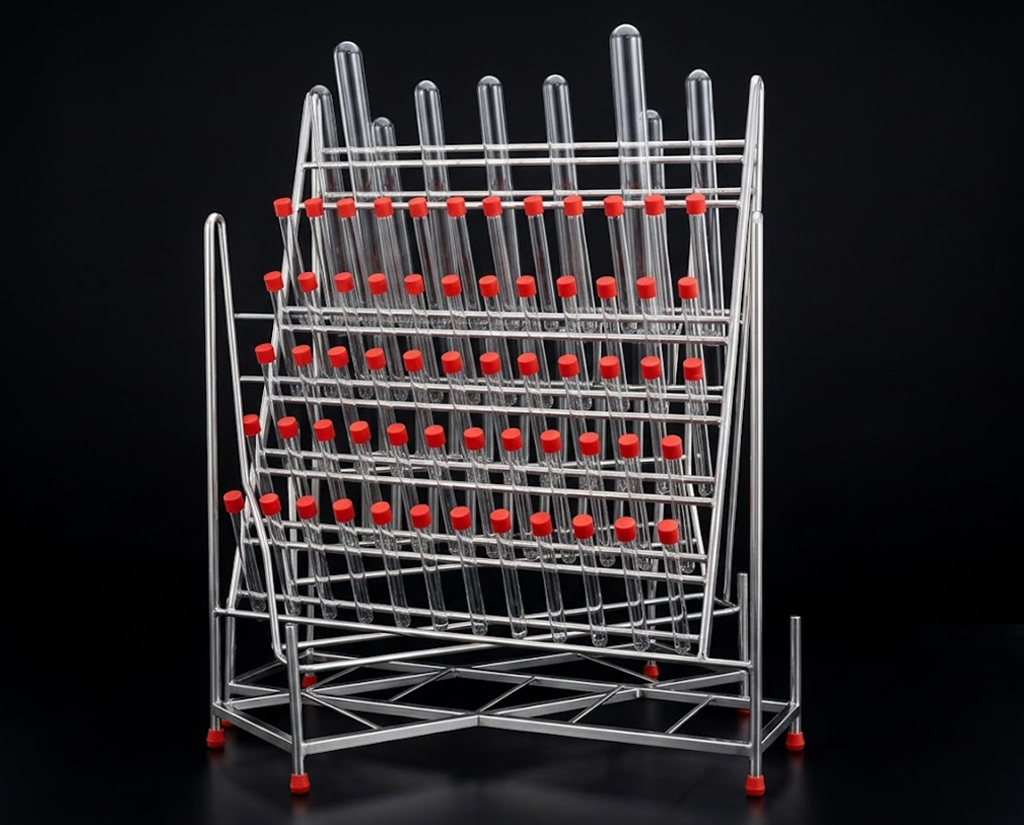
A wall-mounted drying board for washed laboratory glassware in a school chemistry classroom. Test tubes, flasks, burettes, cylinders and funnels are hung mouth-down on the peg holders so water drains into the collecting tray and the inner surfaces air-dry.

Thank you! Your submission has been received!
Oops! Something went wrong while submitting the form.

Specification

icon plus
  • Purpose: drying washed laboratory glassware — test tubes, flasks, burettes, cylinders, funnels
  • Design: wall panel with rows of peg holders; glassware is placed mouth-down so water drains by gravity and inner surfaces are ventilated
  • Number of peg holders: 32
  • Peg spacing: sized for test tubes and burettes; wide glassware (flasks, cylinders, funnels) is hung skipping adjacent pegs, so one such vessel occupies several drying positions
  • Liquid collecting tray: included, fixed under the holders, removable for emptying without dismounting the board
  • Back panel: protective, sits flush against the wall
  • Mounting: mounting lugs for wall installation above the classroom sink
  • Overall dimensions: 40 × 50 cm
  • Recommended age: 10 years and older (grade 5 and above), under the supervision of a teacher
  • Compliance: complies with the general product safety requirements of EU legislation. Not electrical or electronic equipment, so the WEEE marking does not apply
  • Warranty: 3 years; spare parts and consumables available for 5 years

Product passport: ULABS-C009 (PDF)

Additional info

icon plus

Installation

  • Mount the board above or next to the classroom sink so drips fall into the tray and the sink, not onto benches and instruments. Choose a height at which the top row of holders is within easy arm's reach without a step.
  • Mount only on a solid wall able to carry the mass of the board together with wet glassware, using fasteners suited to the wall material.
  • Level the board, mark the holes through the mounting lugs, drill and fix it so that the protective back panel sits flush against the wall over its whole area — it is the panel that takes the water running off the glassware.
  • Fit the tray under the holders and check that it collects water from every row and can be removed for emptying without dismounting the board.
  • Before first use wipe the holders and the tray with a damp cloth and let them dry. Hang a few test tubes and check that they sit firmly and the board does not wobble.

Operation

  • Hang only washed and rinsed glassware; shake the water off over the sink first so the tray does not overflow.
  • Place vessels mouth-down onto the holders as far as they go, checking that the peg has entered the neck and the vessel does not wobble.
  • Put test tubes and burettes on the upper rows and wide, heavy glassware on the lower ones: this reduces the load on the upper fixing and glassware does not fall from height.
  • Leave a gap between neighbouring vessels so they do not touch when hung or removed and air circulates freely around them. Hang flasks, cylinders and funnels every second or third peg.
  • Do not place cracked or chipped glassware, or glassware with reagent residues, on the holders — wash it first.
  • Do not dry glassware heavier than the holder is designed for: a heavy flask slides off the peg and falls into the sink.
  • Remove glassware once it is dry and free the holders — the board is not intended for permanent storage.
  • Empty the tray after every series of works; an overfilled tray spills onto the floor and a wet floor is dangerous.

Maintenance

  • Wipe the holders, back panel and tray with a damp cloth and then dry — standing water leaves deposits and encourages mould behind the board. Wash the tray periodically with a neutral agent and rinse it.
  • At least once per school term check the tightness of the wall fixing and the condition of the holders; loose, bent or cracked pegs are not used until repaired or replaced.
  • Do not load the board with foreign objects and do not use it as a coat rack. Do not clean it with abrasives or solvents that damage the coating.

Storage and transport

  • Store in a dry, clean, ventilated room at +5 °C to +40 °C and relative humidity of 60 % (non-condensing), protected from direct sunlight, moisture, dust and heat sources.
  • Room air must be free of impurities that cause corrosion of metals.
  • Operating conditions: air temperature +5 °C to +40 °C, relative humidity 40 % to 60 %, atmospheric pressure 84 to 107 kPa.

Disposal

  • The product is not electrical or electronic equipment and carries no WEEE marking. It contains no hazardous substances and is disposed of as municipal solid waste after separation by material.

icon plus
How long is the MIKKO Course?
Is the MIKKO Course good for new teachers
How long is the MIKKO Course?
Ask something?
More information

More information

Related products
view all

What our clients are saying about us.
view all

Customer testimonials

What our clients are saying about us.

Working with UNOWA was a turning point for our university. Their expert-led training in ABA, ADOS-2 and MIKKO reshaped how we think, teach, and prepare inclusive educators. The model inclusion classroom they equipped has become a living lab, a space where theory becomes hands-on skill. This partnership didn’t just support a project. It laid the foundation for a more humane, modern and inclusive education system in Kazakhstan.
Yerkin Zhumankulova
Vice-Rector in Academic Affairs. Kazakh National Women's Teacher Training University
Thanks to UNOWA’s innovative approach and professional guidance, we’ve redefined how we prepare future educators. The MIKKO training and inclusion lab brought international best practices to our university, not just as theory, but as living, hands-on tools that inspire confidence and real change.
Irina Rovnyakova
Vice-Rector for Strategic Development and International Relations. Sarsen Amanzholov East Kazakhstan University
Working with the UNOWA team was a valuable and supportive experience in delivering psychological and educational projects. Their reliable platform, openness to dialogue, and continuous technical support allowed me to focus on the quality and meaning of education. I confidently recommend UNOWA as a trusted partner for the development of psychological education and human-centered support.
Liudmyla Lahuta
President of the International Institute of Psychological Maturity INC
Thanks to our partnership with UNOWA, even schools in Armenia’s most remote regions now have access to fully equipped science and technology labs. Nearly half of the country’s schools have been modernized, bringing equal learning conditions to every student, no matter where they live.
Zhanna Andreasyan
Minister of Education, Science, Culture and Sport. The Government of the Republic of Armenia
UNOWA's national project equipped 14 Kazakhstan universities with inclusive classrooms to a unified standard. They delivered top-quality kits, equipment, digital courses with 24/7 access, and localized resources. This game-changer strengthened inclusive education foundations nationwide.
Dastan Yessenov
Coordinator of the PIU of World Bank in the Republic of Kazakhstan
UNOWA's national-level ABA and ADOS-2 training became a milestone for Kazakhstan's education system. The program was comprehensive, well-structured, and perfectly aligned with inclusive education modernization goals nationwide. I appreciated the balance of deep theory, practical sessions, and 24/7 online access. This strengthened specialists' ABA and diagnostics skills, directly improving support for children with special needs.
Karlygash Zholdassova
Inclusion Education Specialist of PIU of World Bank in the Republic of Kazakhstan
icon arrow left
icon arrow right

Customer testimonials

What our clients are saying about us.

UNOWA's national project equipped 14 Kazakhstan universities with inclusive classrooms to a unified standard. They delivered top-quality kits, equipment, digital courses with 24/7 access, and localized resources. This game-changer strengthened inclusive education foundations nationwide.
Dastan Yessenov
Coordinator of the PIU of World Bank in the Republic of Kazakhstan
UNOWA's national-level ABA and ADOS-2 training became a milestone for Kazakhstan's education system. The program was comprehensive, well-structured, and perfectly aligned with inclusive education modernization goals nationwide. I appreciated the balance of deep theory, practical sessions, and 24/7 online access. This strengthened specialists' ABA and diagnostics skills, directly improving support for children with special needs.
Karlygash Zholdassova
Inclusion Education Specialist of PIU of World Bank in the Republic of Kazakhstan
Working with the UNOWA team was a valuable and supportive experience in delivering psychological and educational projects. Their reliable platform, openness to dialogue, and continuous technical support allowed me to focus on the quality and meaning of education. I confidently recommend UNOWA as a trusted partner for the development of psychological education and human-centered support.
Liudmyla Lahuta
President of the International Institute of Psychological Maturity INC
Thanks to our partnership with UNOWA, even schools in Armenia’s most remote regions now have access to fully equipped science and technology labs. Nearly half of the country’s schools have been modernized, bringing equal learning conditions to every student, no matter where they live.
Zhanna Andreasyan
Minister of Education, Science, Culture and Sport. The Government of the Republic of Armenia
Thanks to UNOWA’s innovative approach and professional guidance, we’ve redefined how we prepare future educators. The MIKKO training and inclusion lab brought international best practices to our university, not just as theory, but as living, hands-on tools that inspire confidence and real change.
Irina Rovnyakova
Vice-Rector for Strategic Development and International Relations Sarsen Amanzholov East Kazakhstan University
Working with UNOWA was a turning point for our university. Their expert-led training in ABA, ADOS-2 and MIKKO reshaped how we think, teach, and prepare inclusive educators. The model inclusion classroom they equipped has become a living lab, a space where theory becomes hands-on skill. This partnership didn’t just support a project. It laid the foundation for a more humane, modern and inclusive education system in Kazakhstan.
Yerkin Zhumankulova
Vice-Rector in Academic Affairs Kazakh National Women's Teacher Training University
icon arrow left
icon arrow right
Drying Board
Speak to expertimage of finger pointing to a graph