
A non-academic guide to the study, its implications, and its limitations.
The UNOWA Six Developmental Domains pilot study began with a measurement question: when we assess different areas of child functioning, should sensory processing in child development be interpreted the same way as cognitive, social, physical, or daily living development?
The pilot results suggest the answer may be no. That doesn't mean the study established a final model. It means the data showed a pattern strong enough to justify a different hypothesis — and further validation. Here's what the study actually found.
Who Was Included in the Pilot?
The analysis included 153 children aged 18–83 months. Five functional domains were analysed in this pilot:
- Cognitive
- Social
- Physical
- Sensory
- Daily Living
Although the broader framework is titled "Six Developmental Domains," this pilot analysis covered five domains. That distinction matters when communicating the findings — the sixth domain wasn't part of this dataset.
What Would We Normally Expect From a Developmental Domain?
Developmental skills generally change with age. That doesn't mean every child follows the same path, or that age explains everything. But at group level, a developmental score would usually be expected to show a meaningful relationship with age.
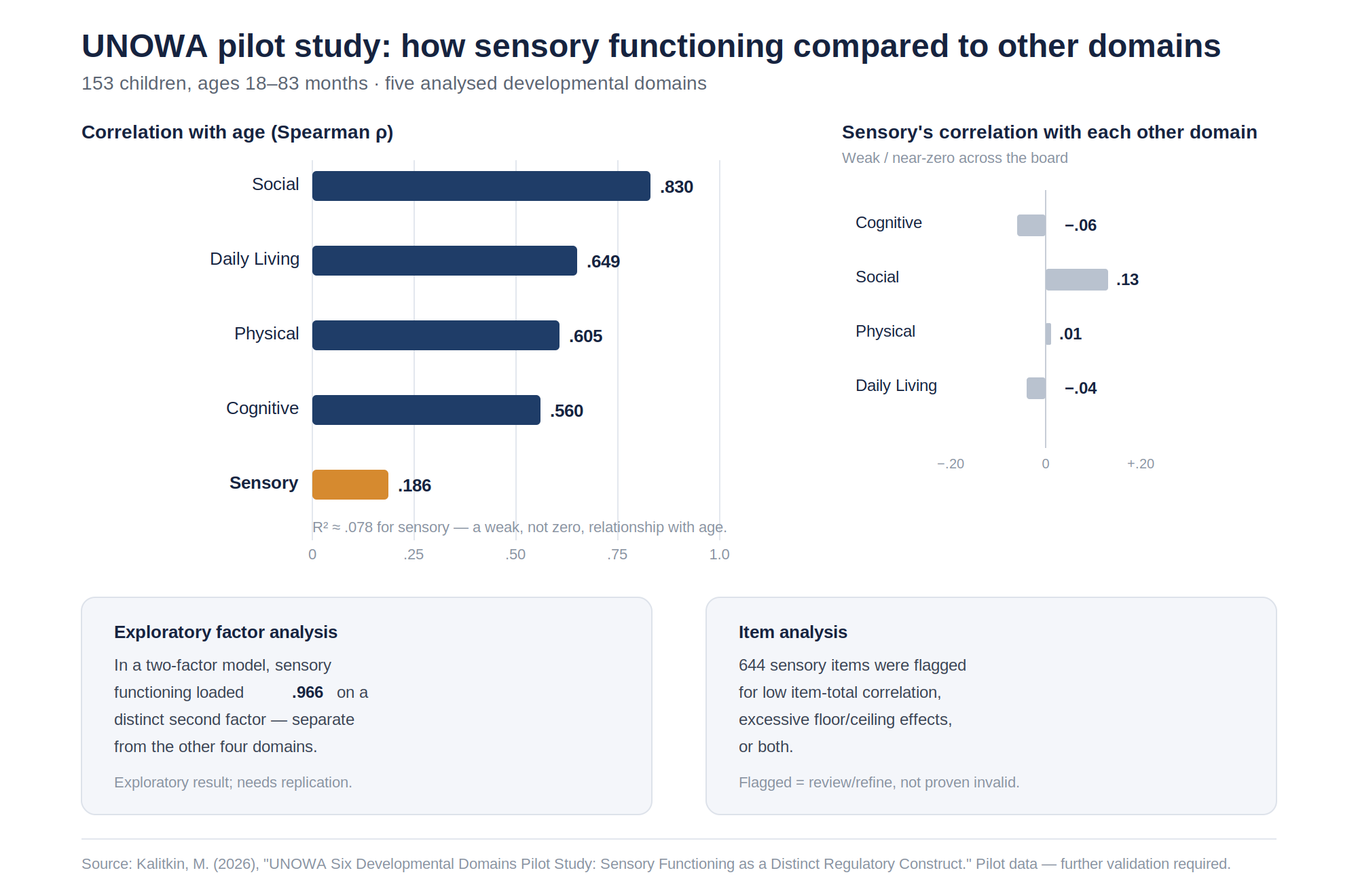
That pattern held for four of the five domains. The reported Spearman correlations with age:
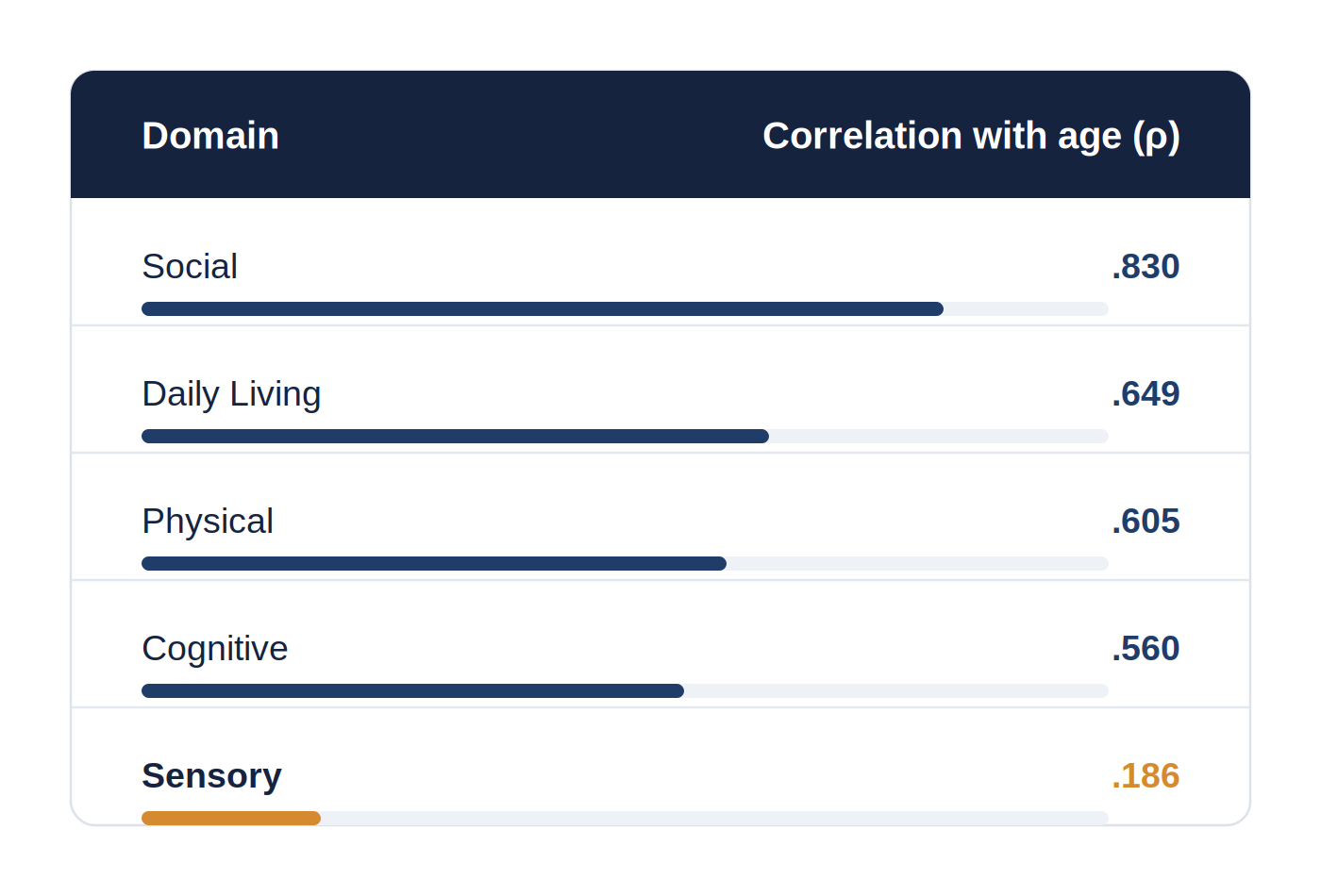
In the simple model reported in the study, age explained about 7.8% of the variance in sensory scores. The important point isn't that sensory functioning has "nothing to do with age" — the correlation was weak, not zero, and the study is a pilot. The more defensible conclusion: sensory functioning didn't behave like a simple age-linear developmental domain in this sample.
Sensory Functioning Was Also Weakly Related to the Other Domains
The sensory domain showed weak or near-zero correlations with the other analysed developmental domains:
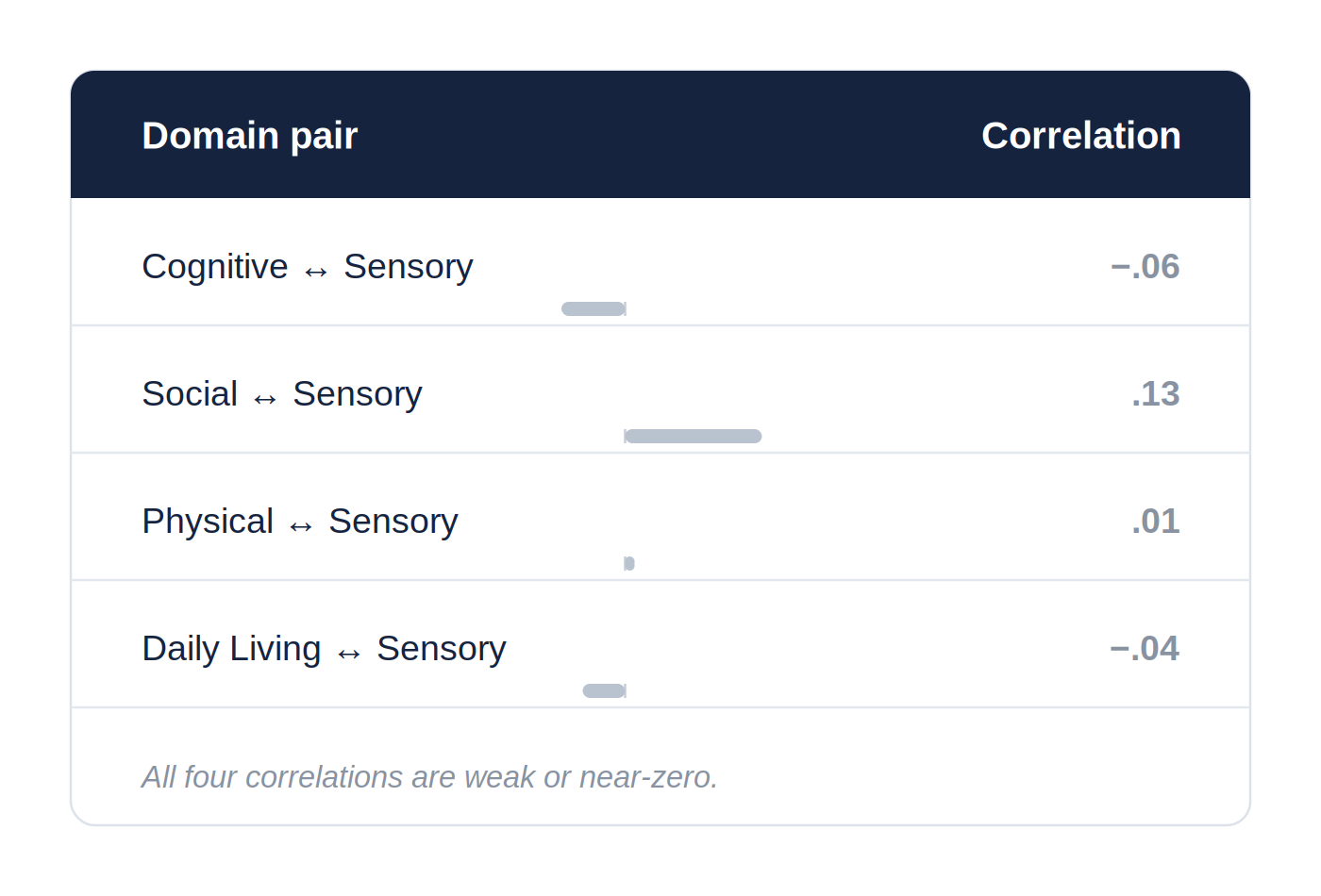
This shouldn't be read as proof that sensory functioning is completely independent of development. But within the pilot data, it behaved differently enough to raise a structural question: are we measuring another developmental level, or a different kind of functional information?
The Factor Analysis Added Another Clue
Exploratory factor analysis was used to examine the underlying structure of the domains. In the two-factor model, sensory functioning loaded .966 on a distinct second factor.
That result supports the idea that sensory functioning may not belong to the same general developmental factor as the other domains. Because this was exploratory analysis in a pilot sample, the finding needs replication — but it gave the study a clearer hypothesis: sensory functioning may be better interpreted as a distinct regulatory construct.
What Does "Regulatory Construct" Mean in Practical Terms?
Developmental assessment often asks: what can the child do? Can they complete the task, communicate, use a motor skill, participate socially, manage a daily activity?
A sensory-regulatory interpretation asks a different question: under what conditions can the child use those abilities?
This distinction can matter in real environments. A child may understand a task but struggle to demonstrate that ability in a noisy setting. A child may want to participate but find certain sensory demands overwhelming. A child may have the physical skill an activity requires but struggle during unpredictable transitions.
The paper discusses examples such as auditory overload, movement needs, tactile demand, and transition difficulty — along with possible support responses like reducing unnecessary noise, adding visual instructions, using smaller-group conditions, allowing movement opportunities, creating more predictable routines, or giving advance warning before transitions.
These are examples, not a universal intervention protocol. A particular behaviour doesn't prove a particular sensory need. The value of the distinction is that it encourages a more precise assessment question — which is the practical thread running through our companion pieces on inclusive assessment for schools and differentiated support planning.
Capability and Access to Capability Are Not the Same Thing
This is probably the single most useful practical idea in the paper: a child can have a skill without being able to use that skill consistently under every set of conditions.
That means an assessment may need to describe two different layers:
- Developmental capability
- Conditions affecting access to participation
If the first layer is the problem, the response may involve teaching or scaffolding a skill. If the second layer is relevant, the support question may involve the environment, presentation of information, transitions, or other regulatory demands. These are different support decisions, which is exactly why conflating the two layers into one score can obscure the right next step.
What Did the Pilot Reveal About the Sensory Item Pool?
The study also identified a measurement problem worth addressing directly. In the sensory item analysis, 644 items were flagged under the pilot criteria because of low item-total correlation, excessive floor/ceiling effects, or both.
"Flagged" doesn't mean all 644 items were conceptually wrong. It means the current item pool doesn't yet provide the psychometric discrimination needed for a final standardised structure.
One likely reason: sensory functioning isn't one homogeneous trait. Different sensory-response patterns may get compressed when they're summarised into a single global score. The paper recommends more differentiated sensory subscales as part of future refinement.
What Still Needs to Be Validated?
The study is explicit about its limitations. Further work includes:
- Refining the sensory item pool
- Developing more differentiated sensory subscales
- Using larger samples
- Establishing test-retest reliability
- Validating results against established sensory instruments
- Repeating factor analysis after revision
These limitations are essential to the interpretation. The study shouldn't be used to claim that the UNOWA assessment is fully scientifically validated. It didn't test whether MIKKO improves learning outcomes. It didn't validate an AI diagnostic system. And it didn't establish a national implementation model. Those are different questions, and this pilot doesn't answer them.
What About AI?
The paper discusses AI-assisted interpretation as a future direction — which matters because the pilot highlights why measurement quality has to come before automated interpretation.
If sensory functioning represents a different construct from developmental capability, an AI system shouldn't treat those scores as interchangeable. And if the sensory item structure still needs refinement, AI shouldn't turn that uncertainty into artificial confidence.
A responsible sequence: define the construct → test the measurement → refine the structure → validate it → then explore AI-assisted interpretation. The pilot contributes to the earlier stages of that sequence. For more on this, see our piece on responsible AI in education.
So What's the Main Takeaway?
The study doesn't conclude that sensory functioning is unrelated to development. It doesn't conclude that every observable behaviour has a sensory cause. And it doesn't present a finished, validated assessment system.
What it does show is a consistent pilot pattern: sensory functioning behaved differently from the other analysed developmental domains. That pattern supports a useful hypothesis — sensory functioning may be better understood as a distinct regulatory layer that helps describe the conditions under which a child can participate and use existing skills.
For inclusive education, that distinction matters. Assessment shouldn't only help us understand what a child can do — it should help us ask what may be getting in the way of participation, and what needs investigating next. That's not the end of the research. It's a more precise place to continue it.
.png)
FAQ
What is sensory processing in child development? Sensory processing describes how a child receives, filters, and responds to sensory input — sound, touch, movement, and more. It shapes attention, behaviour, and how available a child is for learning, somewhat independently of cognitive or social skill level.
Did the UNOWA pilot study prove sensory functioning is unrelated to age? No. Sensory functioning showed a statistically significant but weak correlation with age (ρ = .186, R² = .078) — weak, not zero. The more accurate conclusion is that it didn't behave like the other, more strongly age-linked domains in this sample.
What does it mean that 644 sensory items were "flagged"? It means those items didn't yet show strong enough discrimination under the pilot's statistical criteria — not that they were conceptually invalid. The study treats this as a signal to build more differentiated subscales, not evidence that the construct itself is wrong.
Has this pilot been validated for use in AI-driven or diagnostic tools? No. The paper discusses AI-assisted interpretation only as a future direction. The sensory construct itself still needs larger samples, test-retest reliability, and external validation before that's a responsible next step.
Where can I read the original study? The full paper is Kalitkin, M. (2026), "UNOWA Six Developmental Domains Pilot Study: Sensory Functioning as a Distinct Regulatory Construct in Multidimensional Developmental Assessment," available at sciformat.ca.

Check out other articles
Explore the latest perspectives from our digital research team
Equipping 439 schools: what a national STEM rollout actually takes
Armenia aims to equip every school with a science laboratory by the end of 2026. A look at the delivery layer of a 439-school rollout: seven laboratory configurations, 1.8 million items, 200+ localised teaching materials — and what ministries should ask suppliers.

Responsible AI in Education Starts Before the Algorithm
Responsible AI in education depends on knowing what your data actually represents. A UNOWA pilot study shows why measurement validity has to come before AI interpretation.
Differentiated Support in Inclusive Education: Why a Score Is Only the Start
Differentiated support in inclusive education starts where scoring ends. Here's why assessment should answer "what's getting in the way," not just "what's wrong."