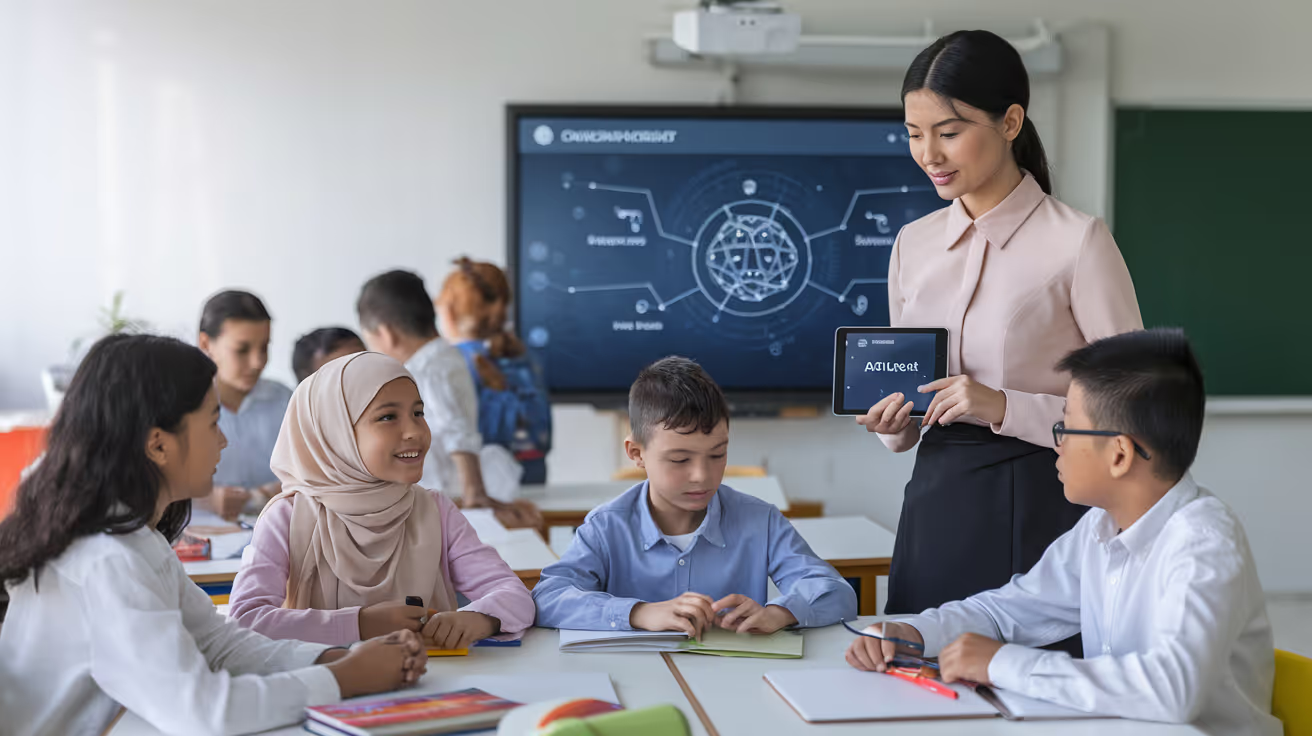

Kazakhstan is rapidly emerging as a regional leader in leveraging artificial intelligence (AI) to align its digital curriculum with the demands of a future-ready workforce. At UNOWA, we are proud to support and empower educational institutions, educators, and students in Kazakhstan and beyond, as they navigate this transformative journey. This article explores Kazakhstan’s use of AI for digital curriculum alignment, offering insights, statistics, and proven strategies for ministries, project leaders, and education professionals across the EU, MENA, and CIS regions.
Why Kazakhstan’s AI Education Strategy Matters
Kazakhstan’s education sector is at a pivotal crossroads. With a growing youth population and a dynamic labor market, the need for innovative, resilient, and inclusive educational solutions has never been greater. The government’s ambitious AI-driven reforms are not only shaping national policy but also setting a benchmark for other countries seeking to modernize their education systems.
Key Facts: Kazakhstan’s AI-Driven Curriculum Transformation
- By 2025, 650,000 students in Kazakhstan are projected to acquire basic AI skills through a network of 43 ICT academies and over 20 specialized educational programs.
- The government has established an AI Academic Cluster with a combined computational power of 2 PFLOPS, distributed across leading universities such as Al-Farabi KazNU, L.N. Gumilyov ENU, and Satbayev University.
- Kazakhstan’s tech industry is growing at 9.36% annually, with a national goal to train 100,000 IT professionals.
- A $100 million Deep Tech Fund, launched in partnership with Saudi Arabia’s NDTP, is fueling AI startups and educational innovation across Central Asia and the MENA region.
Government Policies and International Partnerships
Kazakhstan’s Ministry of Science and Higher Education is spearheading the AI education initiative, emphasizing ethical AI use, equity, and accessible education for all. The government’s approach is holistic, focusing on:
- Teacher training and curriculum development to ensure educators are equipped to deliver AI-aligned content.
- Smart campus development in partnership with global tech leaders like Huawei, introducing advanced AI infrastructure and R&D capabilities.
- International collaboration, drawing on successful models from Estonia’s large-scale AI deployment and Finland’s “Elements of AI” program, which educated over 1% of its population in AI fundamentals.
For more on international best practices in AI education, see Finland’s Elements of AI and Estonia’s AI strategy.
How AI Aligns Kazakhstan’s Digital Curriculum
Kazakhstan’s strategy is not just about integrating technology — it’s about transforming the entire learning experience. AI is being used to:
- Personalize learning pathways for students, adapting content to individual needs and abilities.
- Analyze curriculum gaps and align educational materials with both national standards and global competencies.
- Support inclusive education, ensuring that students with special educational needs (SEN) have access to adaptive learning resources.
- Enhance teacher effectiveness through AI-powered analytics and professional development tools.
At UNOWA, we are committed to supporting these efforts with our own curriculum-aligned content, inclusive education solutions (MIKKO), and advanced analytics platforms. Our experience delivering over 300 national projects positions us as a trusted partner for ministries and educational institutions seeking to implement AI-driven reforms.
Unique Insights: Local Adaptation and Global Inspiration
Kazakhstan’s approach stands out for its adaptation of international models to local realities. Rather than simply importing solutions, the country is:
- Customizing AI curricula to reflect Kazakh language, culture, and societal needs.
- Prioritizing equity and resilience, with a focus on narrowing achievement gaps between urban/rural and socio-economic groups.
- Investing in futures literacy, with support from UNESCO to build foresight capacities in higher education.
As Rita Almeida, a leading education expert, notes:
“Kazakhstan, like many middle-income countries, stands at a crossroads. The megatrends of demography, technology, climate, and AI are not future risks — they are current realities. Education systems must become more resilient, innovative, and equitable to keep up.” — The Astana Times
Recent News and Ongoing Initiatives
- In 2025, Kazakhstan announced a landmark partnership with Huawei for smart campus development and the deployment of the Huawei Atlas 900 AI Cluster.
- The country is scaling up AI education through collaborations with leading universities and organizations, including Heriot-Watt University and SEOLTECH.
- UNESCO’s recent national foresight training is enhancing the capacity of higher education institutions to anticipate and adapt to future challenges.
For more on UNESCO’s role in educational transformation, visit UNESCO’s Futures of Education.
Challenges and Opportunities
While Kazakhstan has made significant strides, challenges remain:
- Ensuring equitable access to AI-powered education, especially in rural and underserved communities.
- Balancing rapid technological adoption with the imperative for ethical use and data privacy.
- Building digital and media literacy to prepare students for a complex, information-rich world.
At UNOWA, we believe that these challenges are also opportunities — to innovate, collaborate, and create more inclusive and future-ready education systems.
Proven Strategies for Successful AI Curriculum Alignment
Drawing from Kazakhstan’s experience and our own expertise, we recommend the following strategies for ministries and educational leaders:
- Invest in teacher training and professional development to build AI literacy and pedagogical skills.
- Leverage data and analytics to inform curriculum design and monitor student progress.
- Foster international partnerships to exchange best practices and accelerate innovation.
- Prioritize inclusivity by developing adaptive learning resources for students with diverse needs.
- Engage stakeholders — including educators, students, and parents — in the reform process for greater buy-in and sustainability.
For more insights on implementing large-scale educational reforms, explore our solutions at UNOWA.
FAQ: Kazakhstan AI Education and Digital Curriculum Alignment
Q: How is Kazakhstan using AI to improve its education system? A: Kazakhstan is integrating AI into its digital curriculum to personalize learning, align content with national and global standards, and support teacher effectiveness. The government is investing in infrastructure, teacher training, and international partnerships to build a future-ready education system.
Q: What are the main benefits of AI-driven curriculum alignment? A: AI enables personalized learning, identifies curriculum gaps, enhances inclusivity, and provides real-time analytics for educators and policymakers. This leads to improved student outcomes and greater equity in education.
Q: How is Kazakhstan ensuring equitable access to AI-powered education? A: The government is expanding access through ICT academies, specialized programs, and partnerships with global tech leaders. There is a strong focus on narrowing achievement gaps and providing adaptive resources for students with special needs.
Q: What role does UNOWA play in supporting AI education in Kazakhstan? A: We design and deliver complete educational systems — including curriculum-aligned content, inclusive education solutions, and analytics — tailored to national standards and local needs. Our mission is to empower institutions, educators, and students to thrive in a rapidly changing world.
Q: Where can I learn more about Kazakhstan’s AI education initiatives? A: For further reading, visit The Astana Times, UNESCO’s Futures of Education, and UNOWA.
Kazakhstan’s bold embrace of AI for digital curriculum alignment is a powerful example of how innovation, inclusivity, and strategic partnerships can transform national education systems. At UNOWA, we are dedicated to supporting this transformation — empowering educators to create a brighter future for all students.
Let’s work together to shape the future of education. Contact us for a consultation.

Check out other articles
Explore the latest perspectives from our digital research team

Equipping 439 schools: what a national STEM rollout actually takes
Armenia aims to equip every school with a science laboratory by the end of 2026. A look at the delivery layer of a 439-school rollout: seven laboratory configurations, 1.8 million items, 200+ localised teaching materials — and what ministries should ask suppliers.

Responsible AI in Education Starts Before the Algorithm
Responsible AI in education depends on knowing what your data actually represents. A UNOWA pilot study shows why measurement validity has to come before AI interpretation.

Differentiated Support in Inclusive Education: Why a Score Is Only the Start
Differentiated support in inclusive education starts where scoring ends. Here's why assessment should answer "what's getting in the way," not just "what's wrong."