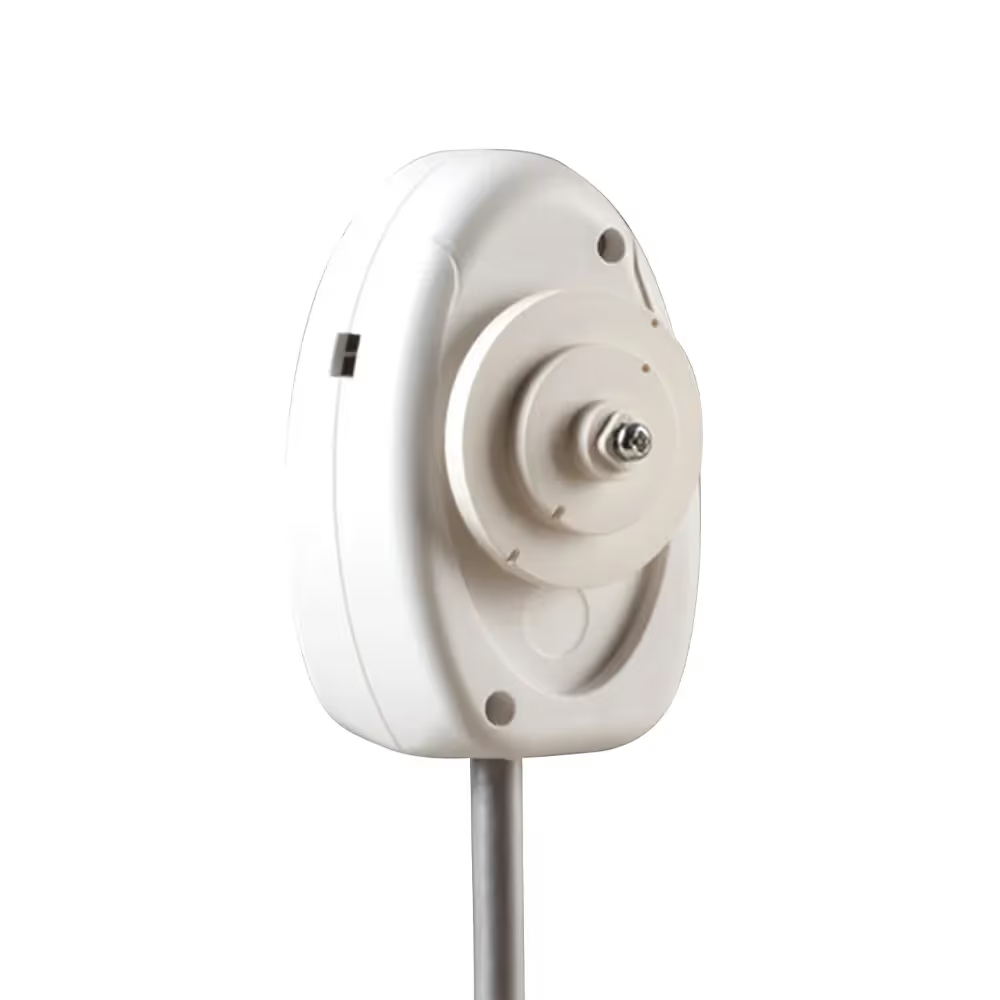
Wireless turbidity sensor

ULabs
sens-at-018
Sensorium

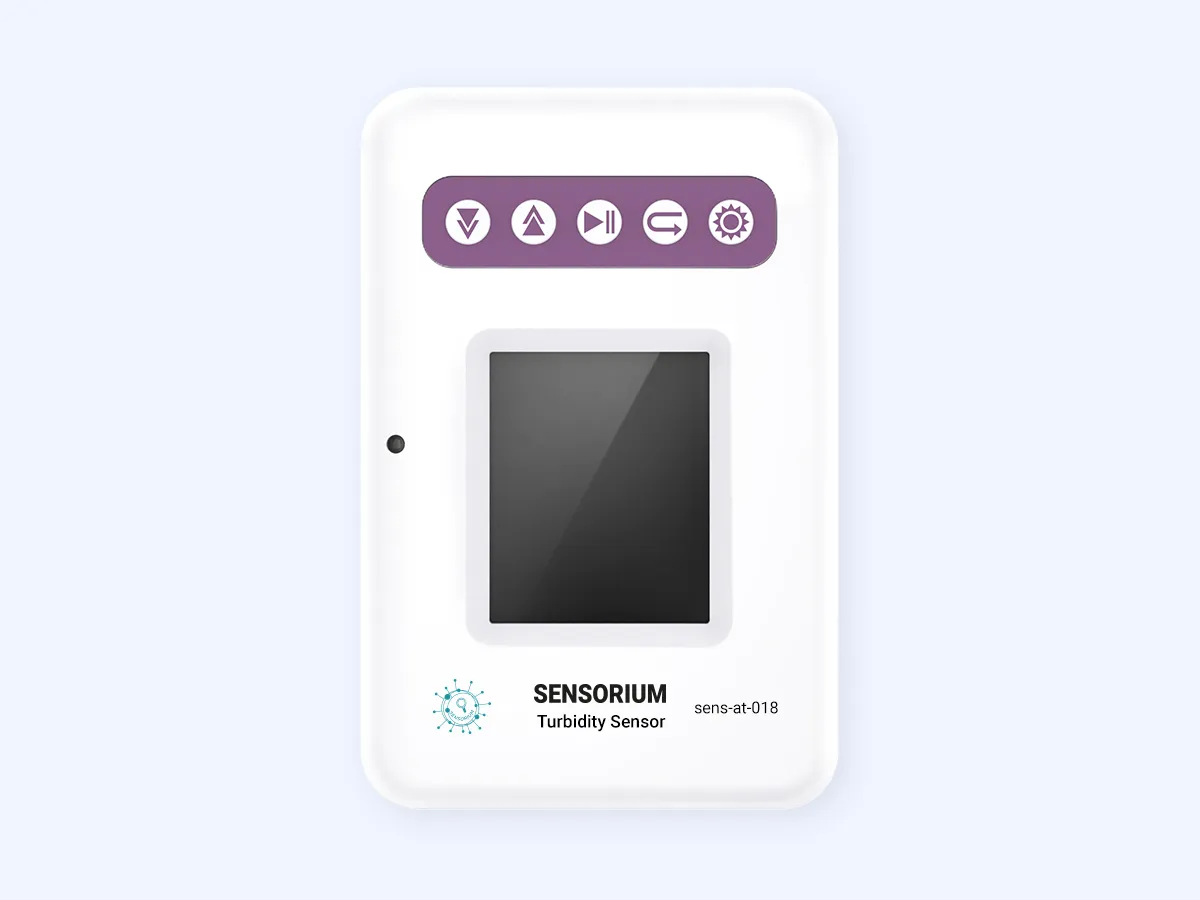
Turbidity sensor utilizing 90° light scattering to measure water clarity and suspended particles.

Thank you! Your submission has been received!
Oops! Something went wrong while submitting the form.

Specification

icon plus

Working Principle

Infrared light is projected into the sample cuvette, and the light is refracted in various directions due to particles in the water. A detector composed of photodiodes is positioned at a 90° angle to the light source. The refracted light is measured and converted into voltage data, which is then transformed into turbidity data in units of NTU.

Measurement Capabilities

Range: 0–400 NTU

Resolution: 0.1 NTU

Structure and Functions

  1. Equipped with a 1.8-inch color LCD screen.
  2. Configured with five functional buttons for simple and convenient operation.
  3. Supports high-speed USB data transfer for rapid communication with data collectors.
  4. Enables wireless communication with experimental terminals.
  5. Features a built-in high-capacity removable battery.
  6. Includes a sensor interface with snap fasteners, compatible with standard sensors for combined experiments.
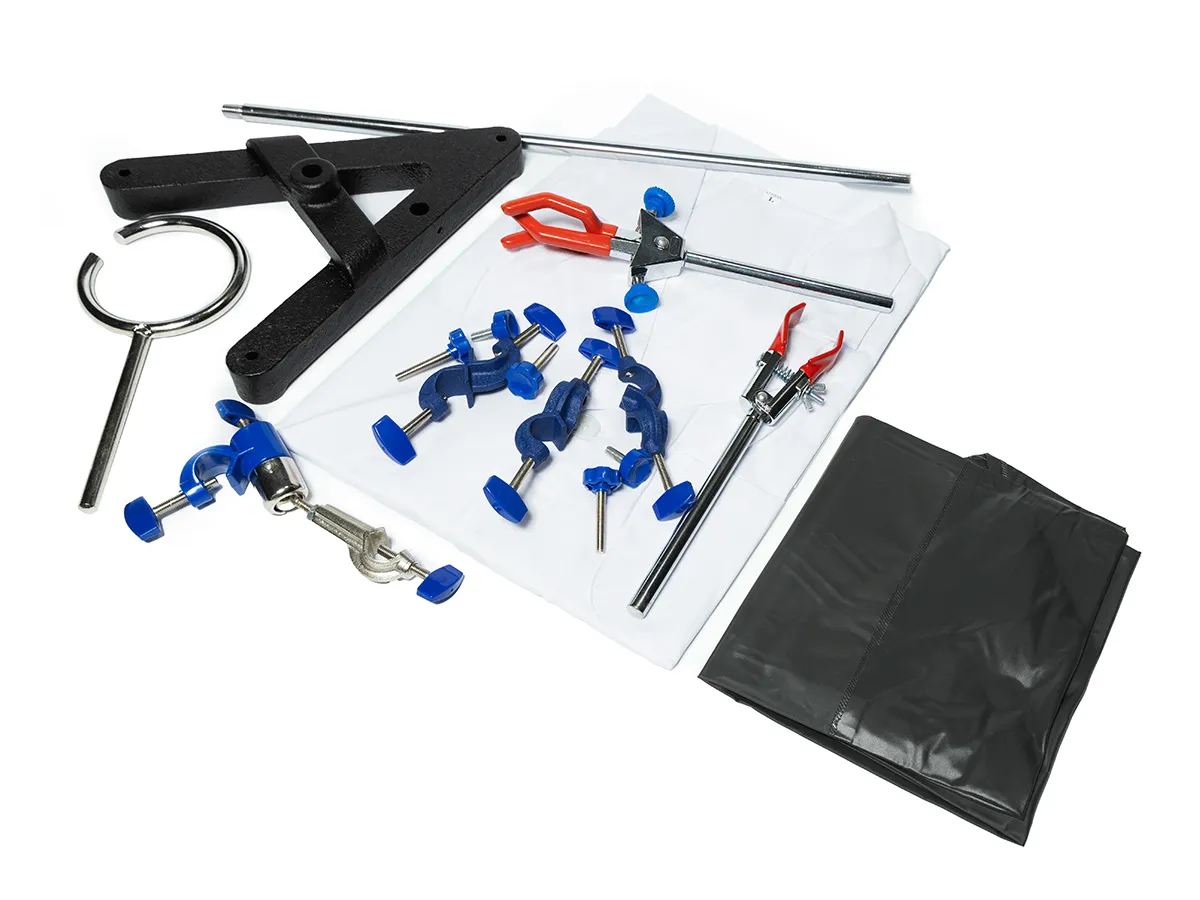
  7. Equipped with a fixed mount for attachment to iron stands, allowing integration with traditional equipment.
  8. The sensor is compatible with common operating systems such as iOS, Android, and Windows.

Powered by AI

icon plus

Built‑in AI functions open new possibilities for data analysis, automated processing of results, and the creation of interactive experiments.

Additional info

icon plus

Typical Applications

This sensor is used to measure the clarity of water, which is a critical indicator of water quality. High turbidity indicates cloudy water, while low turbidity signifies clear water. Suspended particles in water can reflect light, causing opacity. Thus, the more suspended particles present, the cloudier the water. Applications include measuring turbidity before and after water filtration, monitoring turbidity in chemically treated solutions, and analyzing turbidity in water containing various bacteria.

Note

This product is suitable for educational purposes only and is not intended for industrial, medical, research, or commercial applications.

Usage Tips

  1. For accurate readings, fill the cuvette with at least 4 mL of sample up to the cap, tighten the cap to prevent light leakage, and avoid measuring under strong light.
  2. Avoid using or diluting dark-colored samples, as they may introduce greater errors.
  3. Before measuring turbidity, remove "suspended solids" or large, visible sediment particles from the sample (using a pipette or filter) to prevent erroneous readings.
  4. For precise measurements, conduct the test immediately after sample preparation, before suspended particles settle.
  5. Gently invert the cuvette to ensure uniform mixing of fine particles. Avoid vigorous shaking or creating bubbles.
  6. After use, rinse the sample cuvette with distilled water.
  7. Typically, add 2.5–4 mL of test solution to the container, ensuring the liquid level is above the diode's emission angle to avoid measurement errors.
How long is the MIKKO Course?
Is the MIKKO Course good for new teachers
How long is the MIKKO Course?
Ask something?
More information

What it is

Wireless sensor with built‑in AI features that unlock new possibilities for data analysis and make experiments highly interactive.

Who it’s for

Ideal for school laboratories, university courses, and STEM projects.

Benefits

  • Fully wireless connection — mobility and ease of use.
  • Wide range of experiments in physiology, ecology, biochemistry, and cell biology.
  • The sensor is designed for both teachers and students, providing a complete learning cycle: from experiment setup to real‑time analysis and interpretation of results for K-12 curriculum.

Innovation

Built‑in AI functions open new possibilities for data analysis, automated processing of results, and the creation of interactive experiments.

More information

What it is

Wireless sensor with built‑in AI features that unlock new possibilities for data analysis and make experiments highly interactive.

Who it’s for

Ideal for school laboratories, university courses, and STEM projects.

Benefits

  • Fully wireless connection — mobility and ease of use.
  • Wide range of experiments in physiology, ecology, biochemistry, and cell biology.
  • The sensor is designed for both teachers and students, providing a complete learning cycle: from experiment setup to real‑time analysis and interpretation of results for K-12 curriculum.

Innovation

Built‑in AI functions open new possibilities for data analysis, automated processing of results, and the creation of interactive experiments.

Related products
view all

What our clients are saying about us.

view all

Customer testimonials

What our clients are saying about us.

Working with UNOWA was a turning point for our university. Their expert-led training in ABA, ADOS-2 and MIKKO reshaped how we think, teach, and prepare inclusive educators. The model inclusion classroom they equipped has become a living lab, a space where theory becomes hands-on skill. This partnership didn’t just support a project. It laid the foundation for a more humane, modern and inclusive education system in Kazakhstan.
Yerkin Zhumankulova
Yerkin Zhumankulova
Thanks to UNOWA’s innovative approach and professional guidance, we’ve redefined how we prepare future educators. The MIKKO training and inclusion lab brought international best practices to our university, not just as theory, but as living, hands-on tools that inspire confidence and real change.
Irina Rovnyakova
Vice-Rector in Academic Affairs. Kazakh National Women's Teacher Training University
Working with the UNOWA team was a valuable and supportive experience in delivering psychological and educational projects. Their reliable platform, openness to dialogue, and continuous technical support allowed me to focus on the quality and meaning of education. I confidently recommend UNOWA as a trusted partner for the development of psychological education and human-centered support.
Liudmyla Lahuta
Liudmyla Lahuta
Thanks to our partnership with UNOWA, even schools in Armenia’s most remote regions now have access to fully equipped science and technology labs. Nearly half of the country’s schools have been modernized, bringing equal learning conditions to every student, no matter where they live.
Zhanna Andreasyan
President of the International Institute of Psychological Maturity INC
UNOWA's national project equipped 14 Kazakhstan universities with inclusive classrooms to a unified standard. They delivered top-quality kits, equipment, digital courses with 24/7 access, and localized resources. This game-changer strengthened inclusive education foundations nationwide.
Dastan Yessenov
Dastan Yessenov
UNOWA's national-level ABA and ADOS-2 training became a milestone for Kazakhstan's education system. The program was comprehensive, well-structured, and perfectly aligned with inclusive education modernization goals nationwide. I appreciated the balance of deep theory, practical sessions, and 24/7 online access. This strengthened specialists' ABA and diagnostics skills, directly improving support for children with special needs.
Karlygash Zholdassova
Coordinator of the PIU of World Bank in the Republic of Kazakhstan
icon arrow left
icon arrow right

Customer testimonials

What our clients are saying about us.

UNOWA's national project equipped 14 Kazakhstan universities with inclusive classrooms to a unified standard. They delivered top-quality kits, equipment, digital courses with 24/7 access, and localized resources. This game-changer strengthened inclusive education foundations nationwide.
Dastan Yessenov
Coordinator of the PIU of World Bank in the Republic of Kazakhstan
UNOWA's national-level ABA and ADOS-2 training became a milestone for Kazakhstan's education system. The program was comprehensive, well-structured, and perfectly aligned with inclusive education modernization goals nationwide. I appreciated the balance of deep theory, practical sessions, and 24/7 online access. This strengthened specialists' ABA and diagnostics skills, directly improving support for children with special needs.
Karlygash Zholdassova
Inclusion Education Specialist of PIU of World Bank in the Republic of Kazakhstan
Working with the UNOWA team was a valuable and supportive experience in delivering psychological and educational projects. Their reliable platform, openness to dialogue, and continuous technical support allowed me to focus on the quality and meaning of education. I confidently recommend UNOWA as a trusted partner for the development of psychological education and human-centered support.
Liudmyla Lahuta
President of the International Institute of Psychological Maturity INC
Thanks to our partnership with UNOWA, even schools in Armenia’s most remote regions now have access to fully equipped science and technology labs. Nearly half of the country’s schools have been modernized, bringing equal learning conditions to every student, no matter where they live.
Zhanna Andreasyan
Minister of Education, Science, Culture and Sport. The Government of the Republic of Armenia
Thanks to UNOWA’s innovative approach and professional guidance, we’ve redefined how we prepare future educators. The MIKKO training and inclusion lab brought international best practices to our university, not just as theory, but as living, hands-on tools that inspire confidence and real change.
Irina Rovnyakova
Vice-Rector for Strategic Development and International Relations Sarsen Amanzholov East Kazakhstan University
Working with UNOWA was a turning point for our university. Their expert-led training in ABA, ADOS-2 and MIKKO reshaped how we think, teach, and prepare inclusive educators. The model inclusion classroom they equipped has become a living lab, a space where theory becomes hands-on skill. This partnership didn’t just support a project. It laid the foundation for a more humane, modern and inclusive education system in Kazakhstan.
Yerkin Zhumankulova
Vice-Rector in Academic Affairs Kazakh National Women's Teacher Training University
icon arrow left
icon arrow right
Wireless turbidity sensor
Speak to expertimage of finger pointing to a graph