Volume Unit Model

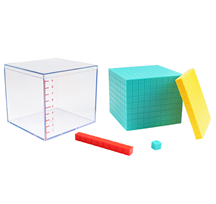
A demonstration model built around a transparent cube container with an edge of 100 mm and four coloured insert elements that fill it completely. Used in K-12 mathematics classrooms to show the unit of volume and how the volume of a rectangular cuboid is calculated.

Thank you! Your submission has been received!
Oops! Something went wrong while submitting the form.

Specification

icon plus
  • Transparent container: cube, 100 x 100 x 100 mm
  • Grid on the faces of the model: 1 x 1 cm, formed by the insert elements; the transparent container additionally carries a measuring scale on its side faces
  • Separable part: the flat element measures 1 cm x 10 cm x 9 cm, and a 1 x 1 cm unit cube separates from the bar taken out of it
  • Number of insert elements: 4 pcs
  • Material: plastic, contrasting colours for frontal demonstration

Kit Contents:

Container
  • Transparent container, cube shape, 100 x 100 x 100 mm, with a measuring scale on the side faces — 1 pc
Insert Elements
  • White block, 100 x 100 x 90 mm, with a 1 x 1 cm grid on its surface — 1 pc
  • Yellow flat block, 1 cm thick, 10 cm x 9 cm in plan, with a 1 x 1 cm grid on its surface — 1 pc
  • Yellow bar, 90 x 10 x 10 mm, with a 1 x 1 cm grid on its surface — 1 pc
  • Red unit cube, 10 x 10 x 10 mm — 1 pc
Demonstration Features
  • Filling: placed into the container one after another, the four elements fill it completely, without gaps or overlaps, showing the composition of a cubic decimetre and the transition to smaller units of volume
  • Unit cube: the edge of the red cube equals one division of the grid
  • Volume of a rectangular cuboid: the three dimensions of any element are read in centimetres against the scale of the container, and their product is compared with the number of unit squares of the grid on its face

Product passport: ULABS-M005 (PDF)

Additional info

icon plus

Operation

  • Take the model out of the packaging and count the components: the transparent container and four insert elements, namely the white block, the yellow block, the yellow bar and the small red cube.
  • Inspect the container: check the walls for cleanliness and transparency and the scale on the side faces for clarity and wear.
  • Check the fit of each element: all four must enter the container freely but without noticeable play, and the grid on them must stay legible. A deformed or warped element does not give a tight fit and the filling sequence falls apart.
  • Place the container on the demonstration desk with the open face upwards and lay the elements beside it in order of decreasing size.
  • Show the class the empty transparent container, a cube with an edge of 100 mm. Run along the scale on the side faces and confirm that all three dimensions are the same. This is the model of the unit of volume, a cubic decimetre.
  • Place the white block of 100 x 100 x 90 mm into the container. It fills almost the whole space, leaving a flat layer 10 mm thick under the top face. Count the unit squares of the grid on the top face of the block to determine the area of the base on which the calculation of volume rests.
  • Put the yellow block of 100 x 90 x 10 mm on the white one. It covers most of the layer, leaving a strip 10 mm wide along the wall of the container.
  • Place the yellow bar of 90 x 10 x 10 mm into that strip. The only space left is now a cubic one with an edge of 10 mm.
  • Fill it with the small red cube of 10 x 10 x 10 mm. The container is completely filled: the four elements together make up a cubic decimetre, leaving no voids.
  • Run the demonstration in reverse: take the elements out one by one, from the small cube to the large block, showing each time which part of the volume has been freed. The volume of the container is the sum of the volumes of the elements placed in it, and every element except the smallest can be mentally divided by the grid into unit cubes.

Safety

  • Use the product only for the purpose described in the passport; students work with it under the supervision of a teacher.
  • Recommended for learners aged 10 years and older (grade 5 and above) in general secondary education institutions.
  • Protect the product from impacts, falling, excessive mechanical loads, moisture, direct sunlight and heaters.
  • Keep the small unit cube and the bar together with the other components inside the container: without them the demonstration cannot be completed.
  • Do not leave small components in places accessible to younger children.
  • Take the insert elements out of the container by their top face, do not push them out by pressing on the transparent side walls.

Maintenance

  • Wash the components with warm water and a neutral detergent and wipe them dry with a soft cloth. Do not use abrasive powders, alcohol-based or solvent cleaners: they cloud the transparent walls of the container and erase the scale and the grid.
  • Do not wash the product with hot water and do not leave it near heaters or in direct sunlight, as the plastic warps and the elements stop fitting tightly together.
  • After every lesson check that the small red cube and the yellow bar are present: these components are lost most often.

Storage and Transport

  • Storage temperature: +5 °C to +40 °C, relative humidity 60 percent, non-condensing, in a dry, clean, ventilated room protected from direct sunlight, moisture, dust and heat sources.
  • Operating conditions: air temperature +5 °C to +40 °C, relative humidity 40 to 60 percent, atmospheric pressure 84 to 107 kPa.
  • Keep the model assembled, with all four elements placed inside the container, in a dry room.
  • The product is supplied packed in the manufacturer's packaging; during transport, protect the packing from precipitation and impacts.

Compliance and Disposal

  • The product complies with the general product safety requirements established by European Union legislation.
  • The product is not electrical or electronic equipment, therefore the WEEE marking does not apply to it.
  • The product contains no hazardous substances and is disposed of as municipal solid waste after separation by material.

Warranty

  • Repair of defects and replacement of defective parts or covered equipment for three (3) years.
  • Availability of spare parts and consumables for five (5) years.

icon plus
How long is the MIKKO Course?
Is the MIKKO Course good for new teachers
How long is the MIKKO Course?
Ask something?
More information

More information

Related products
view all

What our clients are saying about us.

view all

Customer testimonials

What our clients are saying about us.

Working with UNOWA was a turning point for our university. Their expert-led training in ABA, ADOS-2 and MIKKO reshaped how we think, teach, and prepare inclusive educators. The model inclusion classroom they equipped has become a living lab, a space where theory becomes hands-on skill. This partnership didn’t just support a project. It laid the foundation for a more humane, modern and inclusive education system in Kazakhstan.
Yerkin Zhumankulova
Vice-Rector in Academic Affairs. Kazakh National Women's Teacher Training University
Thanks to UNOWA’s innovative approach and professional guidance, we’ve redefined how we prepare future educators. The MIKKO training and inclusion lab brought international best practices to our university, not just as theory, but as living, hands-on tools that inspire confidence and real change.
Irina Rovnyakova
Vice-Rector for Strategic Development and International Relations. Sarsen Amanzholov East Kazakhstan University
Working with the UNOWA team was a valuable and supportive experience in delivering psychological and educational projects. Their reliable platform, openness to dialogue, and continuous technical support allowed me to focus on the quality and meaning of education. I confidently recommend UNOWA as a trusted partner for the development of psychological education and human-centered support.
Liudmyla Lahuta
President of the International Institute of Psychological Maturity INC
Thanks to our partnership with UNOWA, even schools in Armenia’s most remote regions now have access to fully equipped science and technology labs. Nearly half of the country’s schools have been modernized, bringing equal learning conditions to every student, no matter where they live.
Zhanna Andreasyan
Minister of Education, Science, Culture and Sport. The Government of the Republic of Armenia
UNOWA's national project equipped 14 Kazakhstan universities with inclusive classrooms to a unified standard. They delivered top-quality kits, equipment, digital courses with 24/7 access, and localized resources. This game-changer strengthened inclusive education foundations nationwide.
Dastan Yessenov
Coordinator of the PIU of World Bank in the Republic of Kazakhstan
UNOWA's national-level ABA and ADOS-2 training became a milestone for Kazakhstan's education system. The program was comprehensive, well-structured, and perfectly aligned with inclusive education modernization goals nationwide. I appreciated the balance of deep theory, practical sessions, and 24/7 online access. This strengthened specialists' ABA and diagnostics skills, directly improving support for children with special needs.
Karlygash Zholdassova
Inclusion Education Specialist of PIU of World Bank in the Republic of Kazakhstan
icon arrow left
icon arrow right

Customer testimonials

What our clients are saying about us.

UNOWA's national project equipped 14 Kazakhstan universities with inclusive classrooms to a unified standard. They delivered top-quality kits, equipment, digital courses with 24/7 access, and localized resources. This game-changer strengthened inclusive education foundations nationwide.
Dastan Yessenov
Coordinator of the PIU of World Bank in the Republic of Kazakhstan
UNOWA's national-level ABA and ADOS-2 training became a milestone for Kazakhstan's education system. The program was comprehensive, well-structured, and perfectly aligned with inclusive education modernization goals nationwide. I appreciated the balance of deep theory, practical sessions, and 24/7 online access. This strengthened specialists' ABA and diagnostics skills, directly improving support for children with special needs.
Karlygash Zholdassova
Inclusion Education Specialist of PIU of World Bank in the Republic of Kazakhstan
Working with the UNOWA team was a valuable and supportive experience in delivering psychological and educational projects. Their reliable platform, openness to dialogue, and continuous technical support allowed me to focus on the quality and meaning of education. I confidently recommend UNOWA as a trusted partner for the development of psychological education and human-centered support.
Liudmyla Lahuta
President of the International Institute of Psychological Maturity INC
Thanks to our partnership with UNOWA, even schools in Armenia’s most remote regions now have access to fully equipped science and technology labs. Nearly half of the country’s schools have been modernized, bringing equal learning conditions to every student, no matter where they live.
Zhanna Andreasyan
Minister of Education, Science, Culture and Sport. The Government of the Republic of Armenia
Thanks to UNOWA’s innovative approach and professional guidance, we’ve redefined how we prepare future educators. The MIKKO training and inclusion lab brought international best practices to our university, not just as theory, but as living, hands-on tools that inspire confidence and real change.
Irina Rovnyakova
Vice-Rector for Strategic Development and International Relations Sarsen Amanzholov East Kazakhstan University
Working with UNOWA was a turning point for our university. Their expert-led training in ABA, ADOS-2 and MIKKO reshaped how we think, teach, and prepare inclusive educators. The model inclusion classroom they equipped has become a living lab, a space where theory becomes hands-on skill. This partnership didn’t just support a project. It laid the foundation for a more humane, modern and inclusive education system in Kazakhstan.
Yerkin Zhumankulova
Vice-Rector in Academic Affairs Kazakh National Women's Teacher Training University
icon arrow left
icon arrow right
Volume Unit Model
Speak to expertimage of finger pointing to a graph