Tellurium

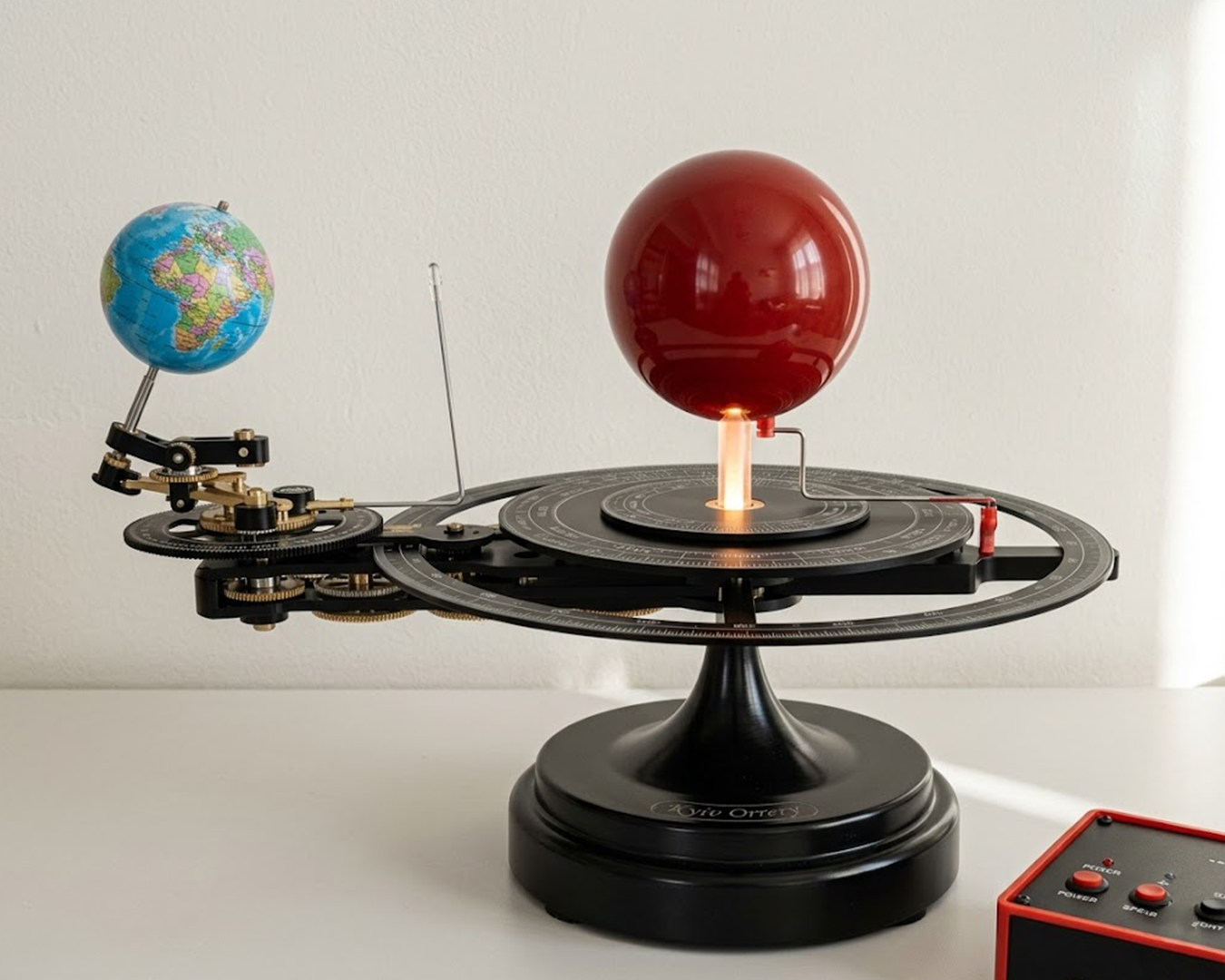
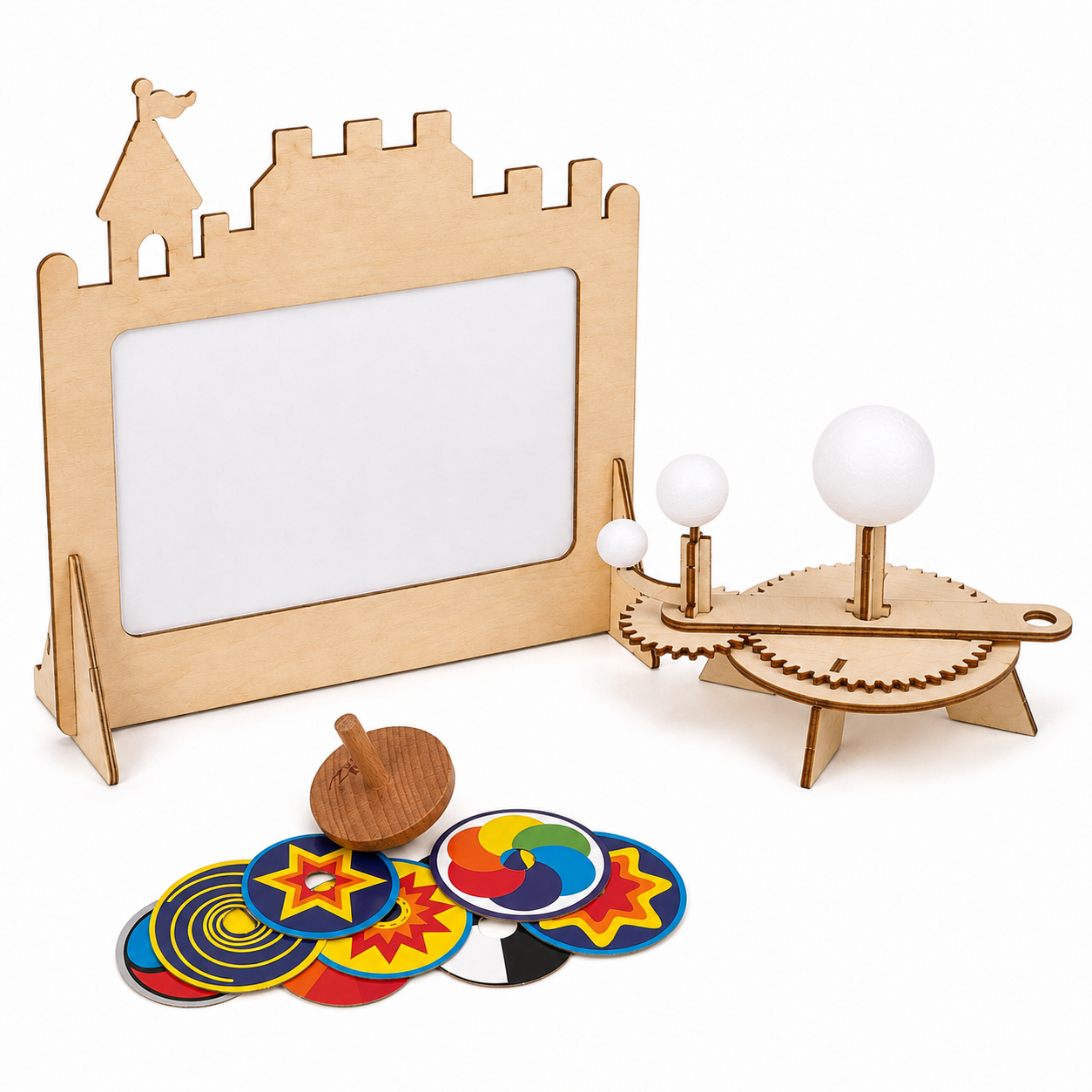
A hand-driven desktop model of the Sun, the Earth and the Moon that demonstrates the motion of the Earth around the Sun and of the Moon around the Earth, the change of seasons, the phases of the Moon and solar and lunar eclipses. The base carries a limb graduated by the months of the year with inscriptions in Ukrainian; intended for K-12 geography, physics and astronomy lessons under the supervision of a teacher.

Thank you! Your submission has been received!
Oops! Something went wrong while submitting the form.

Specification

icon plus
  • Type: moving desktop model of the Sun - Earth - Moon system
  • Purpose: demonstration of the motion of the Earth around the Sun and of the Moon around the Earth in geography, physics and astronomy classrooms
  • Drive: manual, by turning a handle
  • Transmission: the models of the Sun, the Earth and the Moon are mounted on carriers and linked by a mechanical drive, so turning the handle moves the Earth along its orbit around the Sun while rotating it about its own axis and carrying the Moon around the Earth
  • Demonstrated phenomena: motion of the Earth around the Sun, motion of the Moon around the Earth, change of seasons, phases of the Moon, solar and lunar eclipses
  • Earth axis: tilted to the plane of the orbit and keeping a constant direction throughout a full revolution, which reproduces the change in illumination of the hemispheres
  • Limb: graduated by the months of the year with the positions of the Earth, inscriptions in Ukrainian
  • Overall dimensions: approximately 40 x 20 x 30 cm
  • Mains power: not required
  • Marking: complies with the general EU product safety requirements; not electrical or electronic equipment, so the WEEE marking does not apply

Product passport: ULABS-G019 (PDF)

Additional info

icon plus
Preparation for work
  • Place the tellurium on a level horizontal table with free space around it for a full revolution of the carrier with the model of the Earth. The base must rest on all its supports without rocking, otherwise the models catch the table.
  • After unpacking inspect the model: the Sun, Earth and Moon firmly fixed on their holders, the carriers not bent, the limb on the base legible all round. Check that the model of the Earth turns freely about its own axis and that the axis itself is tilted and rigidly fixed in that position.
  • Make one full turn of the handle and check that the movement is smooth, without binding or slipping of the drive. Make sure the direction of the tilt of the Earth axis does not change throughout the revolution - this is the main condition for a correct demonstration of the change of seasons.
  • Before the demonstration set the model of the Earth in its initial position by aligning the index with the required month on the limb. For a demonstration in a darkened room, place the tellurium so that light from an external source falls from the side of the model of the Sun along the plane of the orbit.
Demonstration procedure
  • Turn the handle evenly and slowly, following the movement of the model of the Earth along the limb. One full revolution of the Earth around the Sun corresponds to a year, and the month labels on the limb make it possible to stop the model at any moment of the year.
  • The change of seasons is shown by stopping the Earth in four characteristic positions of the orbit: in two of them the Northern or the Southern hemisphere is tilted towards the Sun, and in the two intermediate ones the axis is tilted neither towards the Sun nor away from it. In each position the boundary between the lit and unlit parts of the model of the Earth is examined.
  • The phases of the Moon are shown by fixing the Earth in one position on the orbit and turning only the carrier of the Moon. Viewed from the side of the model of the Earth, the side of the Moon appears in turn fully lit, half lit and unlit.
  • A solar eclipse is obtained by bringing the Moon exactly between the Sun and the Earth, so that its shadow falls on the surface of the model of the Earth. A lunar eclipse is obtained by bringing the Moon to the opposite position, behind the Earth with respect to the Sun, so that it falls into the shadow of the Earth. In both cases bring the models into one plane with the light source, otherwise the shadow passes by.
  • After the demonstration bring the model smoothly back to its initial position and stop turning. Do not leave the carriers resting against an obstacle and do not fix them with any foreign object.
Safety
  • Turn the handle only in the direction marked on the product and only with the force needed for smooth movement; binding is cleared, not overcome by force.
  • Do not turn the models of the Earth and the Moon by hand, bypassing the drive: this strips the transmission and breaks the agreement between the positions of the bodies.
  • Carry the tellurium only by the base with both hands; do not take it by the carriers, the handle or the models of the celestial bodies.
  • Make sure that there are no hands, objects or edges of other instruments in the path of the carriers while they turn.
  • Before each use check the security of the fastenings, the threaded joints and the integrity of the moving parts; install the product on a stable horizontal surface with free space around the moving elements.
  • Learners work with the product under the supervision of a teacher.
Maintenance
  • Wipe the models, the carriers and the base with a soft dry or slightly damp cloth. Do not wash the limb and its inscriptions with solvents and do not rub them with abrasives: the graduation wears off and the model loses its link to the months of the year.
  • Periodically check the tightness of the threaded joints of the holders and carriers and the condition of the transmission. The axes of rotation and the bearings of the drive are lubricated when needed with a small quantity of machine oil, keeping it off the models and the limb.
  • Keep the tellurium in a dry heated room on a horizontal surface, protected from dust and direct sunlight. Do not place other objects on it: the carriers and the model holders deform even under a small constant load.
Storage, transport and disposal
  • Store in a dry, clean, ventilated room at +5 °C to +40 °C and relative humidity of 60 %, non-condensing, protected from direct sunlight, moisture, dust and heat sources. Keep the storage air free of impurities that cause corrosion of metals.
  • Operating climatic conditions: air temperature +5 °C to +40 °C, relative humidity 40 % to 60 %, atmospheric pressure 84 to 107 kPa (630-800 mmHg).
  • During transport the packed product is secured against movement and protected from precipitation and impact; the product is supplied in the manufacturer's packaging.
  • The product is not electrical or electronic equipment and carries no WEEE marking. It contains no hazardous substances and is disposed of as municipal waste after separation by material, in line with the rules of the operating organisation and the applicable law.
Warranty
  • Warranty obligations cover the elimination of defects and the replacement of defective parts or of the equipment for three years, and the availability of spare parts and consumables for five years.

icon plus
How long is the MIKKO Course?
Is the MIKKO Course good for new teachers
How long is the MIKKO Course?
Ask something?
More information

More information

Related products
view all

What our clients are saying about us.
view all

Customer testimonials

What our clients are saying about us.
Working with UNOWA was a turning point for our university. Their expert-led training in ABA, ADOS-2 and MIKKO reshaped how we think, teach, and prepare inclusive educators. The model inclusion classroom they equipped has become a living lab, a space where theory becomes hands-on skill. This partnership didn’t just support a project. It laid the foundation for a more humane, modern and inclusive education system in Kazakhstan.
Yerkin Zhumankulova
Vice-Rector in Academic Affairs. Kazakh National Women's Teacher Training University
Thanks to UNOWA’s innovative approach and professional guidance, we’ve redefined how we prepare future educators. The MIKKO training and inclusion lab brought international best practices to our university, not just as theory, but as living, hands-on tools that inspire confidence and real change.
Irina Rovnyakova
Vice-Rector for Strategic Development and International Relations. Sarsen Amanzholov East Kazakhstan University
Working with the UNOWA team was a valuable and supportive experience in delivering psychological and educational projects. Their reliable platform, openness to dialogue, and continuous technical support allowed me to focus on the quality and meaning of education. I confidently recommend UNOWA as a trusted partner for the development of psychological education and human-centered support.
Liudmyla Lahuta
President of the International Institute of Psychological Maturity INC
Thanks to our partnership with UNOWA, even schools in Armenia’s most remote regions now have access to fully equipped science and technology labs. Nearly half of the country’s schools have been modernized, bringing equal learning conditions to every student, no matter where they live.
Zhanna Andreasyan
Minister of Education, Science, Culture and Sport. The Government of the Republic of Armenia
UNOWA's national project equipped 14 Kazakhstan universities with inclusive classrooms to a unified standard. They delivered top-quality kits, equipment, digital courses with 24/7 access, and localized resources. This game-changer strengthened inclusive education foundations nationwide.
Dastan Yessenov
Coordinator of the PIU of World Bank in the Republic of Kazakhstan
UNOWA's national-level ABA and ADOS-2 training became a milestone for Kazakhstan's education system. The program was comprehensive, well-structured, and perfectly aligned with inclusive education modernization goals nationwide. I appreciated the balance of deep theory, practical sessions, and 24/7 online access. This strengthened specialists' ABA and diagnostics skills, directly improving support for children with special needs.
Karlygash Zholdassova
Inclusion Education Specialist of PIU of World Bank in the Republic of Kazakhstan
icon arrow left
icon arrow right

Customer testimonials

What our clients are saying about us.

UNOWA's national project equipped 14 Kazakhstan universities with inclusive classrooms to a unified standard. They delivered top-quality kits, equipment, digital courses with 24/7 access, and localized resources. This game-changer strengthened inclusive education foundations nationwide.
Dastan Yessenov
Coordinator of the PIU of World Bank in the Republic of Kazakhstan
UNOWA's national-level ABA and ADOS-2 training became a milestone for Kazakhstan's education system. The program was comprehensive, well-structured, and perfectly aligned with inclusive education modernization goals nationwide. I appreciated the balance of deep theory, practical sessions, and 24/7 online access. This strengthened specialists' ABA and diagnostics skills, directly improving support for children with special needs.
Karlygash Zholdassova
Inclusion Education Specialist of PIU of World Bank in the Republic of Kazakhstan
Working with the UNOWA team was a valuable and supportive experience in delivering psychological and educational projects. Their reliable platform, openness to dialogue, and continuous technical support allowed me to focus on the quality and meaning of education. I confidently recommend UNOWA as a trusted partner for the development of psychological education and human-centered support.
Liudmyla Lahuta
President of the International Institute of Psychological Maturity INC
Thanks to our partnership with UNOWA, even schools in Armenia’s most remote regions now have access to fully equipped science and technology labs. Nearly half of the country’s schools have been modernized, bringing equal learning conditions to every student, no matter where they live.
Zhanna Andreasyan
Minister of Education, Science, Culture and Sport. The Government of the Republic of Armenia
Thanks to UNOWA’s innovative approach and professional guidance, we’ve redefined how we prepare future educators. The MIKKO training and inclusion lab brought international best practices to our university, not just as theory, but as living, hands-on tools that inspire confidence and real change.
Irina Rovnyakova
Vice-Rector for Strategic Development and International Relations Sarsen Amanzholov East Kazakhstan University
Working with UNOWA was a turning point for our university. Their expert-led training in ABA, ADOS-2 and MIKKO reshaped how we think, teach, and prepare inclusive educators. The model inclusion classroom they equipped has become a living lab, a space where theory becomes hands-on skill. This partnership didn’t just support a project. It laid the foundation for a more humane, modern and inclusive education system in Kazakhstan.
Yerkin Zhumankulova
Vice-Rector in Academic Affairs Kazakh National Women's Teacher Training University
icon arrow left
icon arrow right
Tellurium
Speak to expertimage of finger pointing to a graph