Magnetic Stirrer with Heating

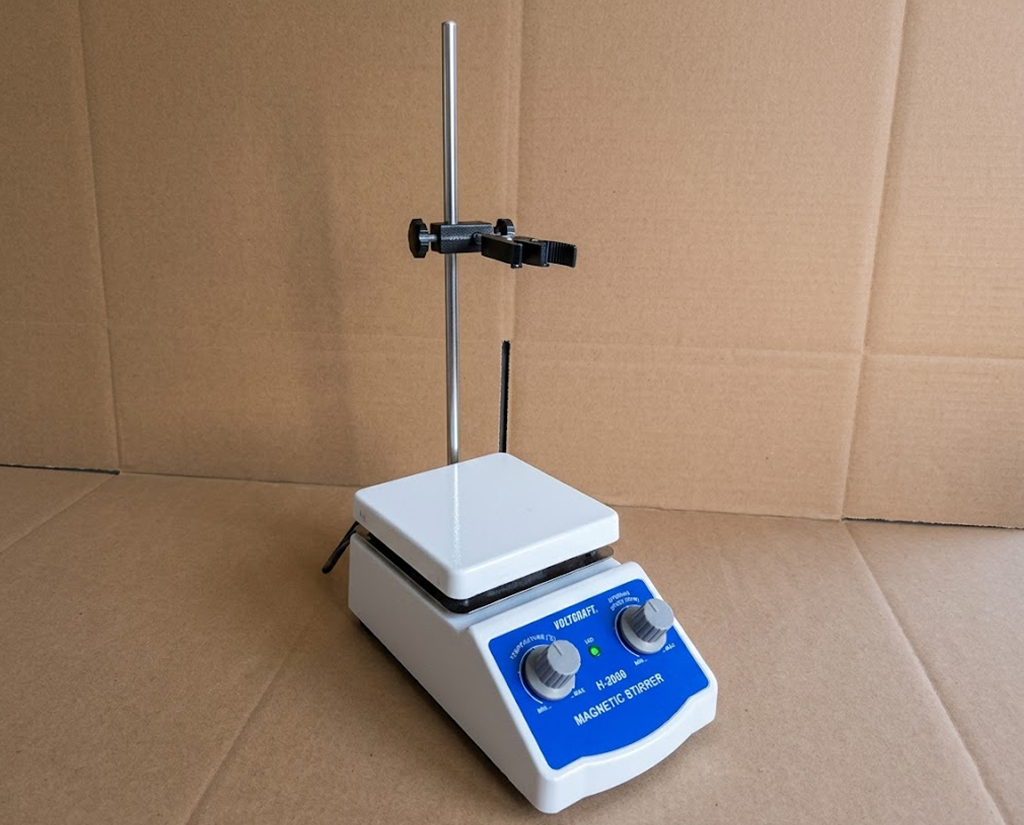
A laboratory magnetic stirrer with a heated plate for school chemistry classrooms: it stirs liquids in glass flasks and other laboratory vessels with a rotating magnetic bar while heating the contents. Stirring speed and plate temperature are set by two separate rotary controls.

Thank you! Your submission has been received!
Oops! Something went wrong while submitting the form.

Specification

icon plus
  • Purpose: stirring liquids in glass flasks with a rotating magnetic bar with simultaneous heating
  • Operating principle: a drive magnet rotates beneath the heating plate and carries the magnetic bar placed in the vessel, creating an even flow without any part of the instrument entering the sample
  • Stirring speed range: 0–1600 rpm, adjustable
  • Maximum heating plate temperature: 280 °C
  • Maximum stirring volume (water): 1 l
  • Heating plate material and design: cast aluminium alloy, sealed design resistant to reagent contact
  • Controls: two rotary controls — heating temperature and magnetic bar rotation speed
  • Support rod with holder for a thermometer or pH sensor: removable, 300 mm long, attaches to the housing so the temperature can be monitored directly in the liquid
  • Magnetic stirring bars with PTFE coating: 3 pcs, 15, 20 and 25 mm long
  • Set contents: stirrer with heating, removable support rod with holder, magnetic bars 15, 20 and 25 mm
  • Power supply: AC mains; rated voltage, frequency and power of the particular model are stated on the rating plate of the product
  • Recommended age: 10 years and older (grade 5 and above), under the supervision of a teacher
  • Compliance: complies with the applicable EU directives and regulations and bears the CE and WEEE markings
  • Warranty: 3 years; spare parts and consumables available for 5 years

Product passport: ULABS-C003 (PDF)

Additional info

icon plus

Preparation for work

  • Unpack the product and inspect the power cord, housing, heating plate and both controls. The heating plate must be flat, free of scratches and reagent marks; the controls must turn with a noticeable detent.
  • Place the instrument on a level non-combustible bench surface with free space around the vessel and with the power cord clear of the heating plate. The product must stand horizontally: if tilted, the vessel moves off centre and the bar loses coupling with the drive magnet.
  • Attach the removable support rod to the housing and fix the holder on it. Set the thermometer or pH sensor so that its sensing part is immersed in the liquid but touches neither the bottom nor the walls of the vessel nor the rotating magnetic bar.
  • Choose a magnetic bar to suit the vessel size and the sample volume and rinse it before work. The bars are PTFE-coated and therefore work in most laboratory solutions; a bar with scratched or blistered coating is withdrawn from use — reagent reaches the magnet through the damage.

Operation

  • Pour the liquid into a heat-resistant glass vessel leaving the top free, and lower the magnetic bar into it gently along the wall rather than dropping it — a falling bar breaks the bottom of a thin-walled flask.
  • Place the vessel in the centre of the heating plate. Centring is the main condition for stable stirring: an off-centre vessel makes the bar jump and knock against the bottom.
  • Start stirring from a low setting of the speed control and increase it gradually, checking that the bar rotates evenly and stays coupled to the drive. A bar that begins to jump erratically indicates excessive speed; reduce the speed until rotation is even again.
  • Set the required heating with the temperature control. Heat together with stirring: a stirred liquid warms evenly and no local overheating occurs near the bottom. Aqueous solutions do not need full heating — 280 °C is used only for samples that require it.
  • Monitor the temperature in the liquid itself using the thermometer or pH sensor held in the rod holder, not by the position of the control: the heating plate temperature is always higher than the sample temperature.
  • When the experiment is finished, first switch off the heating and let the vessel stir for a while to even out the temperature, then stop stirring by reducing the speed to zero. Remove the vessel with heat-resistant tongs, place it on a heat-resistant mat and, once cool, take the bar out with tweezers rather than pouring it out with the solution.

Choosing the magnetic bar and sample volume

  • The bar length should match the diameter of the vessel bottom: 15 mm for test tubes, small beakers and narrow flasks; 20 mm for medium-volume flasks; 25 mm for wide vessels and for samples close to the maximum volume of 1 l. An oversized bar in a narrow vessel catches on the walls, an undersized bar in a wide one does not carry the whole mass of liquid.
  • A sample volume above 1 l of water is not stirred evenly: the magnetic coupling is not enough to overcome the resistance of the liquid and the bar breaks away. Viscous solutions stir less readily than water, so use a smaller volume and a larger bar for them.
  • Choose the rotation speed to suit the experiment. Low settings of the 0–1600 rpm range are used for gentle mixing and for samples with a suspension that should not be broken up; high settings for dissolving solids and for liquids that separate. An evenly formed vortex on the liquid surface without splashing indicates a correctly chosen speed.

Safety

  • Connect the product only to a supply with the voltage, frequency and ratings stated on the rating plate.
  • Provide close supervision when the product is used by students or operates near them; do not leave the switched-on instrument unattended.
  • Do not use the product with a damaged cord or plug, after it has been dropped, or if there is any sign of damage.
  • To reduce the risk of electric shock, do not immerse the product or the cord in liquid and do not expose them to moisture.
  • Switch off and unplug the product when it is not in use and before cleaning; pull the plug, not the cord.
  • Use only accessories recommended by the manufacturer; the product is intended for educational purposes only.
  • Do not touch the heating plate or the vessel during operation and until they have cooled: the plate heats to 280 °C and stays hot after heating is switched off.
  • Place the product on a level non-combustible surface at least 20 cm from walls and combustible materials, work in a room with effective ventilation, and heat volatile substances in a fume hood.
  • Do not heat flammable liquids or tightly closed vessels; do not fill the vessel to the brim — during heating and stirring the liquid level rises and a vortex forms on the surface.
  • Place only heat-resistant glassware with a dry, clean bottom on the plate; cracked or chipped glassware must not be used.
  • Bring the bar up to speed gradually, starting slowly: switching straight to a high speed makes the bar break away from the magnetic coupling and strike the walls and bottom of the vessel.
  • Wipe up solution spilled on the heating plate only after the product has cooled completely, and remove and rinse the thermometer or pH sensor immediately after the experiment.

Maintenance

  • Clean the heating plate after every use, once cooled, wiping it with a soft damp cloth and a neutral agent. Do not use abrasive powders or metal brushes and do not immerse the product in water. Reagent left on the aluminium surface gradually attacks the coating despite its resistance to accidental contact.
  • Wash the magnetic bars with water and a neutral agent and wipe them dry after each experiment, storing them separately from one another. A bar with damaged PTFE coating, a crack or a blister is replaced: it contaminates the sample and rusts.
  • Periodically check the removable rod and holder — the threaded joint of the rod with the housing must be tight and the holder jaws must not slip under the weight of the thermometer or pH sensor.
  • Inspect the power cord, plug and controls. If the cord is damaged, a control turns without changing the setting, or there is no heating or rotation, the product must not be used until repaired at an authorised service centre.
  • Store the product in a dry heated room with the rod removed and nothing resting on the heating plate.

Storage and transport

  • Store at +5 °C to +40 °C and relative humidity of 60 % (non-condensing), protected from direct sunlight, moisture, dust and heat sources; room air must be free of impurities that cause corrosion of metals.
  • Operating conditions: air temperature +5 °C to +40 °C, relative humidity 40 % to 60 %, atmospheric pressure 84 to 107 kPa.

Disposal

  • The product carries the WEEE marking (crossed-out wheeled bin), which prohibits disposal with unsorted municipal waste. Hand it over to a separate collection point for waste electrical and electronic equipment. Metal parts are recycled as scrap metal; electronic components go to specialised processing.

icon plus
How long is the MIKKO Course?
Is the MIKKO Course good for new teachers
How long is the MIKKO Course?
Ask something?
More information

More information

Related products
view all

What our clients are saying about us.
view all

Customer testimonials

What our clients are saying about us.

Working with UNOWA was a turning point for our university. Their expert-led training in ABA, ADOS-2 and MIKKO reshaped how we think, teach, and prepare inclusive educators. The model inclusion classroom they equipped has become a living lab, a space where theory becomes hands-on skill. This partnership didn’t just support a project. It laid the foundation for a more humane, modern and inclusive education system in Kazakhstan.
Yerkin Zhumankulova
Vice-Rector in Academic Affairs. Kazakh National Women's Teacher Training University
Thanks to UNOWA’s innovative approach and professional guidance, we’ve redefined how we prepare future educators. The MIKKO training and inclusion lab brought international best practices to our university, not just as theory, but as living, hands-on tools that inspire confidence and real change.
Irina Rovnyakova
Vice-Rector for Strategic Development and International Relations. Sarsen Amanzholov East Kazakhstan University
Working with the UNOWA team was a valuable and supportive experience in delivering psychological and educational projects. Their reliable platform, openness to dialogue, and continuous technical support allowed me to focus on the quality and meaning of education. I confidently recommend UNOWA as a trusted partner for the development of psychological education and human-centered support.
Liudmyla Lahuta
President of the International Institute of Psychological Maturity INC
Thanks to our partnership with UNOWA, even schools in Armenia’s most remote regions now have access to fully equipped science and technology labs. Nearly half of the country’s schools have been modernized, bringing equal learning conditions to every student, no matter where they live.
Zhanna Andreasyan
Minister of Education, Science, Culture and Sport. The Government of the Republic of Armenia
UNOWA's national project equipped 14 Kazakhstan universities with inclusive classrooms to a unified standard. They delivered top-quality kits, equipment, digital courses with 24/7 access, and localized resources. This game-changer strengthened inclusive education foundations nationwide.
Dastan Yessenov
Coordinator of the PIU of World Bank in the Republic of Kazakhstan
UNOWA's national-level ABA and ADOS-2 training became a milestone for Kazakhstan's education system. The program was comprehensive, well-structured, and perfectly aligned with inclusive education modernization goals nationwide. I appreciated the balance of deep theory, practical sessions, and 24/7 online access. This strengthened specialists' ABA and diagnostics skills, directly improving support for children with special needs.
Karlygash Zholdassova
Inclusion Education Specialist of PIU of World Bank in the Republic of Kazakhstan
icon arrow left
icon arrow right

Customer testimonials

What our clients are saying about us.

UNOWA's national project equipped 14 Kazakhstan universities with inclusive classrooms to a unified standard. They delivered top-quality kits, equipment, digital courses with 24/7 access, and localized resources. This game-changer strengthened inclusive education foundations nationwide.
Dastan Yessenov
Coordinator of the PIU of World Bank in the Republic of Kazakhstan
UNOWA's national-level ABA and ADOS-2 training became a milestone for Kazakhstan's education system. The program was comprehensive, well-structured, and perfectly aligned with inclusive education modernization goals nationwide. I appreciated the balance of deep theory, practical sessions, and 24/7 online access. This strengthened specialists' ABA and diagnostics skills, directly improving support for children with special needs.
Karlygash Zholdassova
Inclusion Education Specialist of PIU of World Bank in the Republic of Kazakhstan
Working with the UNOWA team was a valuable and supportive experience in delivering psychological and educational projects. Their reliable platform, openness to dialogue, and continuous technical support allowed me to focus on the quality and meaning of education. I confidently recommend UNOWA as a trusted partner for the development of psychological education and human-centered support.
Liudmyla Lahuta
President of the International Institute of Psychological Maturity INC
Thanks to our partnership with UNOWA, even schools in Armenia’s most remote regions now have access to fully equipped science and technology labs. Nearly half of the country’s schools have been modernized, bringing equal learning conditions to every student, no matter where they live.
Zhanna Andreasyan
Minister of Education, Science, Culture and Sport. The Government of the Republic of Armenia
Thanks to UNOWA’s innovative approach and professional guidance, we’ve redefined how we prepare future educators. The MIKKO training and inclusion lab brought international best practices to our university, not just as theory, but as living, hands-on tools that inspire confidence and real change.
Irina Rovnyakova
Vice-Rector for Strategic Development and International Relations Sarsen Amanzholov East Kazakhstan University
Working with UNOWA was a turning point for our university. Their expert-led training in ABA, ADOS-2 and MIKKO reshaped how we think, teach, and prepare inclusive educators. The model inclusion classroom they equipped has become a living lab, a space where theory becomes hands-on skill. This partnership didn’t just support a project. It laid the foundation for a more humane, modern and inclusive education system in Kazakhstan.
Yerkin Zhumankulova
Vice-Rector in Academic Affairs Kazakh National Women's Teacher Training University
icon arrow left
icon arrow right
Magnetic Stirrer with Heating
Speak to expertimage of finger pointing to a graph