 Speak to expert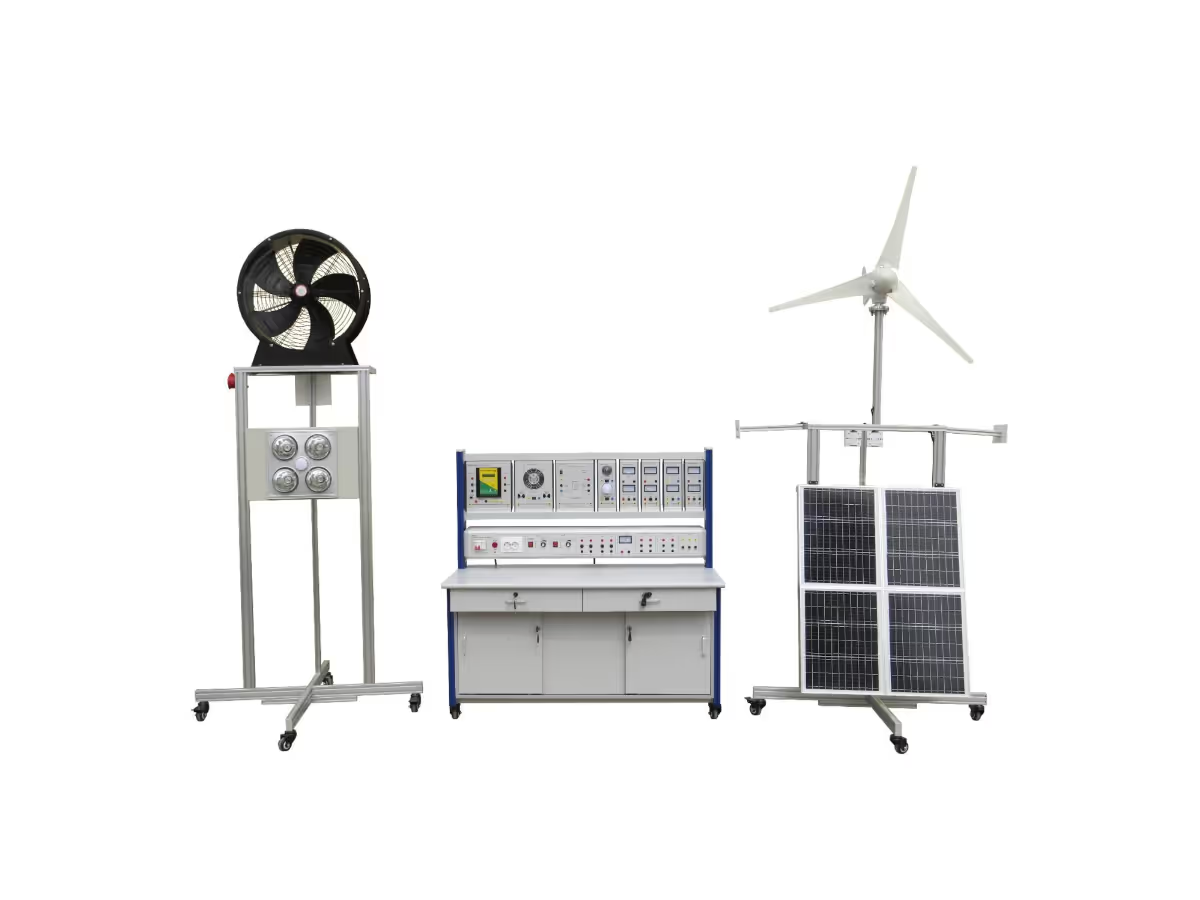

.png)

The training and laboratory stand ""Integrated Wind and Solar Generation" is a comprehensive educational system designed to simulate the processes of electricity generation from wind and sun.

Temperature: from -10 °C to +40 °C
Humidity: ≤ 80%
Air: free of corrosive substances, flammable gases, and high concentrations of conductive dust.
Power consumption: ≤ 5000 W
Operating power supply: AC: ~220 V ±5%, DC: 24 V
Power type: single-phase, three-wire, ~220 V ±5%, 50 Hz
Operating mode: continuous
Relative humidity: 35–85% RH (non-condensing)
Can be equipped with transport rollers for mobility.
This innovative platform allows students to gain practical experience studying renewable energy systems, including wind turbines, solar panels, control systems, and inverters. The bench is ideal for technical universities, training institutes, and technical schools where practical skills in the field of renewable energy technologies are developed.
Aluminum column frame with built-in measuring instruments.
Universal wheels to ensure mobility.
Safety system for the protection of equipment and users.
Ability to assemble various circuits and combine elements to perform a wide range of educational tasks.
The system consists of four main parts:
Wind power generation system
Photovoltaic (solar) generation system
Control system
Inverter system
Consists of a fan, a generator, and a battery.
Wind energy generator: uses a horizontal synchronous magnetic generator driven by a fan.
The fan position can be adjusted to simulate different wind strengths and directions, testing the generator's performance under various conditions.
Consists of a light source, a solar panel, and a battery.
Solar system simulator: contains four solar modules of 30 W each, which can be connected in series or parallel depending on the system conditions.
Two metal-halide light sources are adjustable relative to the solar panel, simulating the position of sunlight and demonstrating its operation.
A combined-type controller (wind/solar) is installed in a hanging box.
An industrial charge controller manages charging from the wind turbine and the solar battery.
An LCD panel allows for monitoring the system's technical parameters and independent configuration, preventing overcharging and current overload.
Inverter in a hanging box: uses an intelligent inverter with 12 V / 24 V frequency recognition; output voltage is 220 V AC.
Rated power: 600 W, peak power: up to 1000 W, efficiency >90%.
Low voltage alert function for additional safety.
Provides the opportunity to observe the internal structure and operating processes, deepening the understanding of renewable energy systems.
Equipped with a protection system, short-circuit protection, and a low-voltage alarm, guaranteeing safe operation during classes.
Students can assemble various circuits, performing experiments with wind and solar systems, control systems, and inverters.
The lower part is equipped with universal wheels with brakes for convenient movement and secure fixation.
The work surface is made of a 25 mm thick board with a high-temperature resistant coating, ensuring long-term use.
Includes three doors and two pull-out drawers for organized storage of tools and accessories, enhancing functionality and aesthetics.
Measuring electrical parameters and verifying series and parallel connections of batteries.
Connection of reverse current protection.
Battery overcharge protection.
Battery deep discharge protection.
Investigation of the reverse charging protection mechanism.
Studying the process of obtaining electricity from a simulated wind turbine with a horizontal magnetic synchronous generator.
Investigation of charge control principles from wind turbines and their impact on battery operation.
Measurement and analysis of generator power under different wind conditions.
Measuring the open-circuit voltage of solar batteries under various illumination levels.
Measuring the short-circuit current of solar batteries to study their electrical characteristics.
Analysis of solar battery output power under different lighting conditions.
Studying the maximum energy generation of a solar battery at different illumination levels.
Studying the output parameters of a solar battery, including changes in voltage and current.
Mastering the principles of solar battery charge control and its integration into the overall system.
Studying reverse current protection mechanisms that prevent energy loss.
Practice in connecting solar batteries in series and parallel circuits to study their characteristics.
Studying the basic principles of inverter operation and their role in converting direct current (DC) to alternating current (AC).
Verifying and analyzing the inverter's output voltage waveform to ensure correct operation.
Using the inverter to power AC loads such as incandescent lamps, energy-saving lamps, and axial fans.
Joint use of a wind turbine and a solar system to study their interaction and increase overall efficiency.
Students interact with real components of wind and solar power generation systems, which deepens the understanding of their functioning.
The bench covers all key aspects of renewable energy sources: wind and solar generation, control systems, and inverters.
The transparent design and digital instruments provide real-time visual monitoring of the system's operation.
Equipped with short-circuit protection and low-voltage warning, guaranteeing safe operation during classes.
The laboratory stand "Integrated Wind and Solar Generation" is modern training equipment that combines real components and advanced simulation capabilities. Its robust frame, interactive features, and wide range of possibilities make it an indispensable solution for teaching and learning modern renewable energy technologies and sustainable engineering.
What our clients are saying about us.




.avif)
.avif)


What our clients are saying about us.