Digital Weather Station with Wireless Sensors

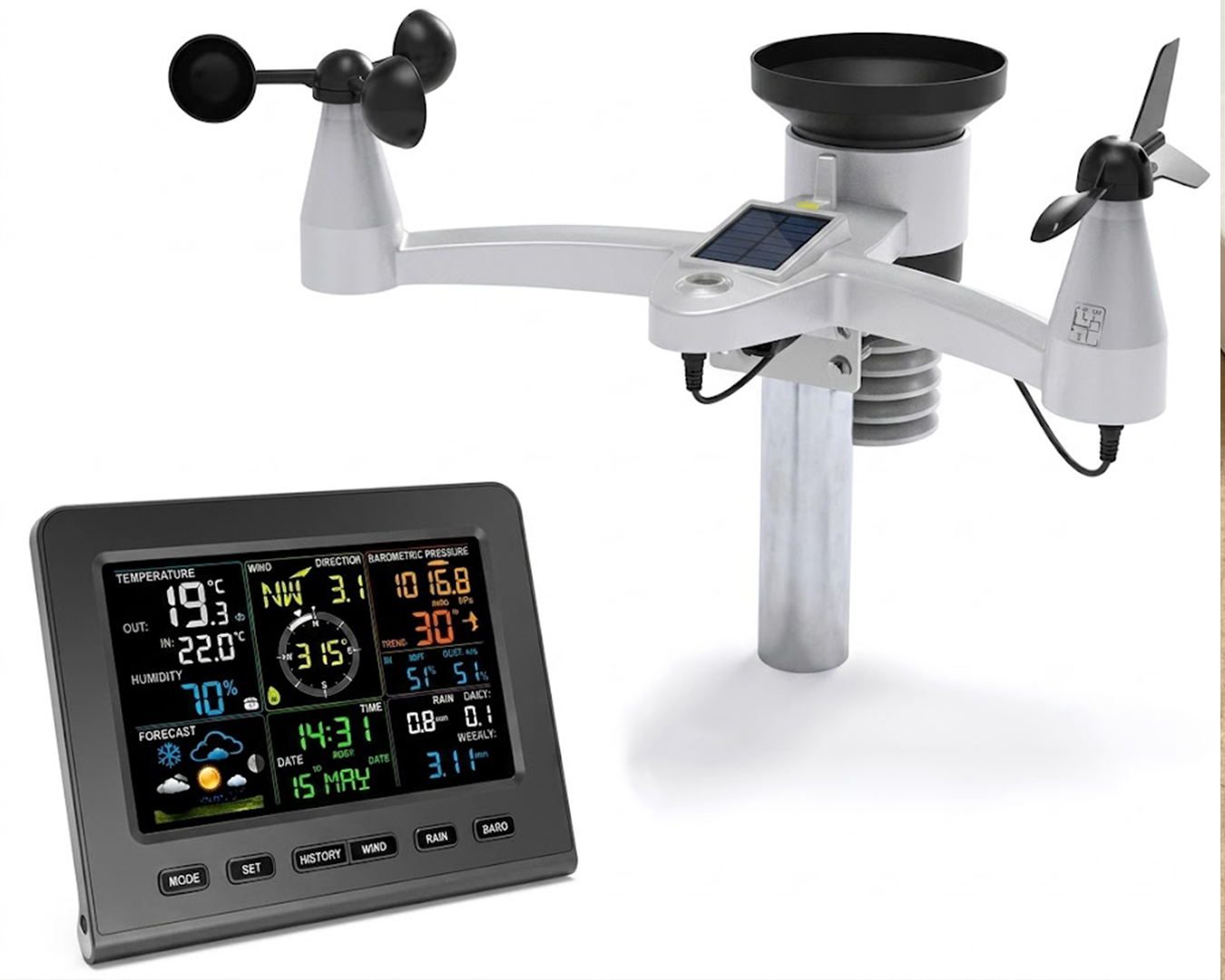
A digital weather station with an indoor display unit and a wireless outdoor transmitter carrying a full group of sensors, for school geography and physics lessons. Students follow air temperature, relative humidity, atmospheric pressure, wind speed and direction, rainfall, illuminance and UV index continuously and keep an observation log from the readings.

Thank you! Your submission has been received!
Oops! Something went wrong while submitting the form.

Specification

icon plus
  • Purpose: continuous measurement of the state of the atmosphere for physics and geography classrooms — indoor and outdoor air temperature, relative humidity, atmospheric pressure, wind speed and direction, rainfall, illuminance and ultraviolet radiation
  • Configuration: indoor main unit (receiver) and a wireless outdoor transmitter with a group of sensors
  • Air temperature: indoor 0 to +60 °C, outdoor -40 to +60 °C; accuracy ±1 °C
  • Relative humidity: 10 to 99 %; accuracy ±5 %
  • Atmospheric pressure: 300 to 1100 hPa; accuracy ±3 hPa
  • Wind speed: 0 to 50 m/s
  • Wind direction: 0 to 360°
  • Rainfall: 0 to 9999 mm; resolution 0.3 mm to 1000 mm and 1 mm above 1000 mm
  • Illuminance: 0 to 200 000 lx; accuracy ±15 %
  • Ultraviolet radiation: UV index 1 to 15+ (UV-B to UV-A); accuracy ±1 level
  • Radio link to the transmitter: 433.92 MHz; range 90 m in open terrain; transmission interval 16 s; no cables between the sensors and the receiver
  • Power supply: receiver — 3 × AAA 1.5 V cells; transmitter — 3 × AA 1.5 V cells and a solar panel; cells are not supplied with the product
  • Main unit dimensions: approximately 170 × 125 mm

Kit Contents:

Main Unit (Receiver), Indoor
  • Main unit with colour LCD and bright colour-changing backlight, approximately 170 × 125 mm, powered by 3 alkaline or lithium AAA 1.5 V cells (not supplied) — 1 pc
  • Built-in indoor air temperature and relative humidity sensor, temperature 0 to +60 °C ±1 °C, humidity 10 to 99 % ±5 % — 1 pc
  • Built-in atmospheric pressure sensor (barometer), 300 to 1100 hPa ±3 hPa — 1 pc
Wireless Outdoor Transmitter with Sensor Group
  • Wireless outdoor transmitter with solar panel supporting its power supply, backup power 3 alkaline or lithium AA 1.5 V cells (not supplied), data transmission at 433.92 MHz every 16 s over 90 m in open terrain — 1 pc
  • Outdoor air temperature and relative humidity sensor, temperature -40 to +60 °C ±1 °C, humidity 10 to 99 % ±5 % — 1 pc
  • Wind speed sensor (anemometer), 0 to 50 m/s, accuracy ±3 m/s in the range 2 to 10 m/s and ±10 % in the range 10 to 50 m/s — 1 pc
  • Wind direction sensor (wind vane), 0 to 360° — 1 pc
  • Rain gauge, 0 to 9999 mm, resolution 0.3 mm for rainfall to 1000 mm and 1 mm above 1000 mm, accuracy ±1 mm to 15 mm and ±7 % in the range 15 to 9999 mm — 1 pc
  • Illuminance sensor, 0 to 200 000 lx, accuracy ±15 % — 1 pc
  • Ultraviolet radiation sensor, UV index 1 to 15+ over the UV-B to UV-A range, accuracy ±1 level — 1 pc
Display and Calculated Values on the Main Unit
  • Current readings of all sensors simultaneously
  • Recorded minimum and maximum values
  • Dew point
  • Wind chill index (temperature as felt in wind)
  • Weather forecast from the barometric trend over the pressure range 300 to 1100 hPa
  • Moon phases, calendar, clock with alarm
  • Alarm when a reading goes outside a set upper or lower limit

Product passport: ULABS-G023 (PDF)

Additional info

icon plus

Preparation for Work

  • Check the contents against the kit list. Inspect the main unit, the transmitter housing, the anemometer cups, the wind vane, the rain gauge funnel and the solar panel: cracks, skew and dirty sensor windows distort the readings, and damaged components must not be used.
  • Fit the cells: three AAA 1.5 V cells in the receiver and three AA 1.5 V cells in the transmitter, alkaline or lithium; they are bought separately. Check the polarity against the markings in the compartment. Switch on the transmitter first and the receiver second — they establish the radio link faster this way.
  • Choose a site for the transmitter: an open place away from walls, trees and heat sources that distort the temperature measurement and block the airflow. Mount the rain gauge strictly horizontally, set the anemometer cups and the wind vane so that they turn freely, and orient the solar panel to the south. Keep the distance to the receiver within 90 m in open terrain; walls, floors and metal structures reduce it.
  • Place the main unit indoors in a visible spot and check that the outdoor sensor readings appear on the display. Set the current time, date and units and define the upper and lower alarm limits for the values you need.

Observation Procedure

  • Current values: data from all sensors reach the main unit simultaneously every 16 s, so the display shows the state of the atmosphere practically in real time. The outdoor sensor does not react instantly — after the transmitter is taken outside or after an abrupt weather change, allow several transmission cycles for the readings to settle.
  • Wind and rainfall: compare readings in calm and windy weather and relate the wind direction to changes in temperature and pressure. The rain gauge accumulates rainfall as a running total; record the reading after each rain and reset the accumulated value before a new series of observations.
  • Pressure, forecast and derived values: the product measures pressure over 300 to 1100 hPa with an accuracy of ±3 hPa and builds a weather forecast from its trend. The display also shows dew point and wind chill index, calculated from the measured temperature, humidity and wind speed; use the recorded minima and maxima to follow the daily course of the values.
  • Illuminance and ultraviolet radiation: compare readings at different hours and under different cloud cover, noting that the maximum UV index and the maximum illuminance do not always occur at the same moment.
  • Observation log: for long-term studies record the readings at the same hours, noting date and time. Such a data series suits plotting the daily and weekly course of temperature, pressure and humidity. Do not move the transmitter in the middle of a series — the results of different days then become incomparable.

Safety

  • Use only cells of the type and rating stated in the manual or on the housing; do not mix new and partly discharged cells and observe the polarity. If electrolyte leaks, remove the cells at once without touching the contents.
  • Remove the cells if the product will not be used for over a month — leaking electrolyte destroys the instrument. Do not recharge non-rechargeable cells and do not throw them into fire.
  • Do not open the housing and do not expose the product to impacts, moisture or direct sunlight.
  • Mounting and servicing the outdoor transmitter at height is done by an adult: work in pairs, from a stable ladder, and do not involve students in this work.
  • Do not install, remove or service the outdoor sensors during a thunderstorm, strong wind, rain or icing; choose a site away from power lines.
  • Fasten the transmitter securely to its mast: an unsecured assembly with the anemometer and wind vane is torn off by the wind and falls from height.
  • The main unit is installed indoors, protected from moisture, direct sunlight and heating appliances; it has no protection against precipitation and is not intended for outdoor installation.
  • When measuring illuminance and UV index, do not look at the sun and do not point optical instruments at it.
  • Do not base decisions about people's safety on the readings: this is an educational instrument and its readings do not replace official meteorological warnings.
  • Students work with the product under the supervision of a teacher; recommended for learners aged 10 and older (grade 5 and up).

Operating and Storage Conditions

  • Air temperature: +5 °C to +40 °C
  • Relative humidity: 40 % to 60 %
  • Atmospheric pressure: 84 to 107 kPa (630-800 mm Hg)
  • Store in a room at +5 °C to +40 °C and relative humidity of 60 %; keep the air free of impurities that corrode metals.

Maintenance

  • Wipe the main unit with a soft dry cloth; it needs no wet cleaning or detergents. Do not block the ventilation openings and do not place the unit near heating appliances — this overstates the indoor temperature reading.
  • Inspect the outdoor transmitter every quarter and after every spell of bad weather. Clear the rain gauge funnel of leaves, dust and insects, otherwise rainfall is collected incompletely; check that the anemometer cups and the wind vane turn freely and keep their axles clean. Wipe the solar panel and the windows of the illuminance and UV sensors with a soft damp cloth — a layer of dust understates the readings. In winter check for ice on the anemometer cups and in the rain gauge funnel.
  • Replace the cells as soon as the readings become unstable or the radio link with the transmitter is lost; fit a complete set of new cells of the same type in both units at once. For long periods out of use, remove the cells from both units, take the transmitter off its mast and move the components to a dry heated room.

Warranty and Disposal

  • Warranty: 3 years, covering defect elimination and replacement of defective parts or equipment; spare parts and consumables available for 5 years.
  • Compliance: the product meets the requirements of the applicable EU directives and regulations and bears the CE and WEEE markings.
  • Disposal: the WEEE marking (crossed-out wheeled bin) prohibits disposal with unsorted municipal waste. Remove the cells before disposal and hand them in separately at a battery collection point; the product goes to a separate collection point for waste electrical and electronic equipment. Metal parts are recycled as scrap metal, electronic components go to specialised processing.

icon plus
How long is the MIKKO Course?
Is the MIKKO Course good for new teachers
How long is the MIKKO Course?
Ask something?
More information

More information

Related products
view all

What our clients are saying about us.

view all

Customer testimonials

What our clients are saying about us.

Working with UNOWA was a turning point for our university. Their expert-led training in ABA, ADOS-2 and MIKKO reshaped how we think, teach, and prepare inclusive educators. The model inclusion classroom they equipped has become a living lab, a space where theory becomes hands-on skill. This partnership didn’t just support a project. It laid the foundation for a more humane, modern and inclusive education system in Kazakhstan.
Yerkin Zhumankulova
Vice-Rector in Academic Affairs. Kazakh National Women's Teacher Training University
Thanks to UNOWA’s innovative approach and professional guidance, we’ve redefined how we prepare future educators. The MIKKO training and inclusion lab brought international best practices to our university, not just as theory, but as living, hands-on tools that inspire confidence and real change.
Irina Rovnyakova
Vice-Rector for Strategic Development and International Relations. Sarsen Amanzholov East Kazakhstan University
Working with the UNOWA team was a valuable and supportive experience in delivering psychological and educational projects. Their reliable platform, openness to dialogue, and continuous technical support allowed me to focus on the quality and meaning of education. I confidently recommend UNOWA as a trusted partner for the development of psychological education and human-centered support.
Liudmyla Lahuta
President of the International Institute of Psychological Maturity INC
Thanks to our partnership with UNOWA, even schools in Armenia’s most remote regions now have access to fully equipped science and technology labs. Nearly half of the country’s schools have been modernized, bringing equal learning conditions to every student, no matter where they live.
Zhanna Andreasyan
Minister of Education, Science, Culture and Sport. The Government of the Republic of Armenia
UNOWA's national project equipped 14 Kazakhstan universities with inclusive classrooms to a unified standard. They delivered top-quality kits, equipment, digital courses with 24/7 access, and localized resources. This game-changer strengthened inclusive education foundations nationwide.
Dastan Yessenov
Coordinator of the PIU of World Bank in the Republic of Kazakhstan
UNOWA's national-level ABA and ADOS-2 training became a milestone for Kazakhstan's education system. The program was comprehensive, well-structured, and perfectly aligned with inclusive education modernization goals nationwide. I appreciated the balance of deep theory, practical sessions, and 24/7 online access. This strengthened specialists' ABA and diagnostics skills, directly improving support for children with special needs.
Karlygash Zholdassova
Inclusion Education Specialist of PIU of World Bank in the Republic of Kazakhstan
icon arrow left
icon arrow right

Customer testimonials

What our clients are saying about us.

UNOWA's national project equipped 14 Kazakhstan universities with inclusive classrooms to a unified standard. They delivered top-quality kits, equipment, digital courses with 24/7 access, and localized resources. This game-changer strengthened inclusive education foundations nationwide.
Dastan Yessenov
Coordinator of the PIU of World Bank in the Republic of Kazakhstan
UNOWA's national-level ABA and ADOS-2 training became a milestone for Kazakhstan's education system. The program was comprehensive, well-structured, and perfectly aligned with inclusive education modernization goals nationwide. I appreciated the balance of deep theory, practical sessions, and 24/7 online access. This strengthened specialists' ABA and diagnostics skills, directly improving support for children with special needs.
Karlygash Zholdassova
Inclusion Education Specialist of PIU of World Bank in the Republic of Kazakhstan
Working with the UNOWA team was a valuable and supportive experience in delivering psychological and educational projects. Their reliable platform, openness to dialogue, and continuous technical support allowed me to focus on the quality and meaning of education. I confidently recommend UNOWA as a trusted partner for the development of psychological education and human-centered support.
Liudmyla Lahuta
President of the International Institute of Psychological Maturity INC
Thanks to our partnership with UNOWA, even schools in Armenia’s most remote regions now have access to fully equipped science and technology labs. Nearly half of the country’s schools have been modernized, bringing equal learning conditions to every student, no matter where they live.
Zhanna Andreasyan
Minister of Education, Science, Culture and Sport. The Government of the Republic of Armenia
Thanks to UNOWA’s innovative approach and professional guidance, we’ve redefined how we prepare future educators. The MIKKO training and inclusion lab brought international best practices to our university, not just as theory, but as living, hands-on tools that inspire confidence and real change.
Irina Rovnyakova
Vice-Rector for Strategic Development and International Relations Sarsen Amanzholov East Kazakhstan University
Working with UNOWA was a turning point for our university. Their expert-led training in ABA, ADOS-2 and MIKKO reshaped how we think, teach, and prepare inclusive educators. The model inclusion classroom they equipped has become a living lab, a space where theory becomes hands-on skill. This partnership didn’t just support a project. It laid the foundation for a more humane, modern and inclusive education system in Kazakhstan.
Yerkin Zhumankulova
Vice-Rector in Academic Affairs Kazakh National Women's Teacher Training University
icon arrow left
icon arrow right
Digital Weather Station with Wireless Sensors
Speak to expertimage of finger pointing to a graph