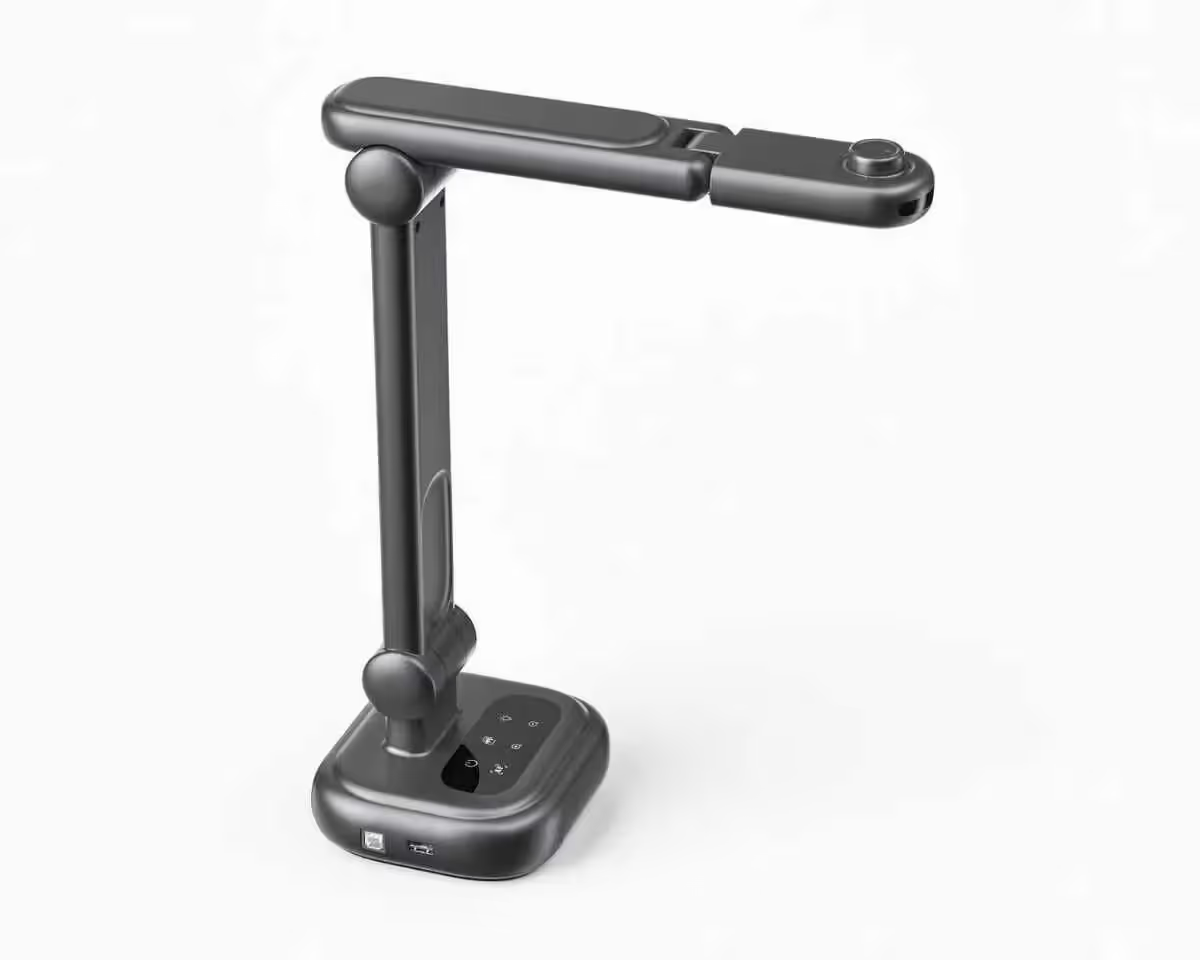
Demonstration Electrostatics Set

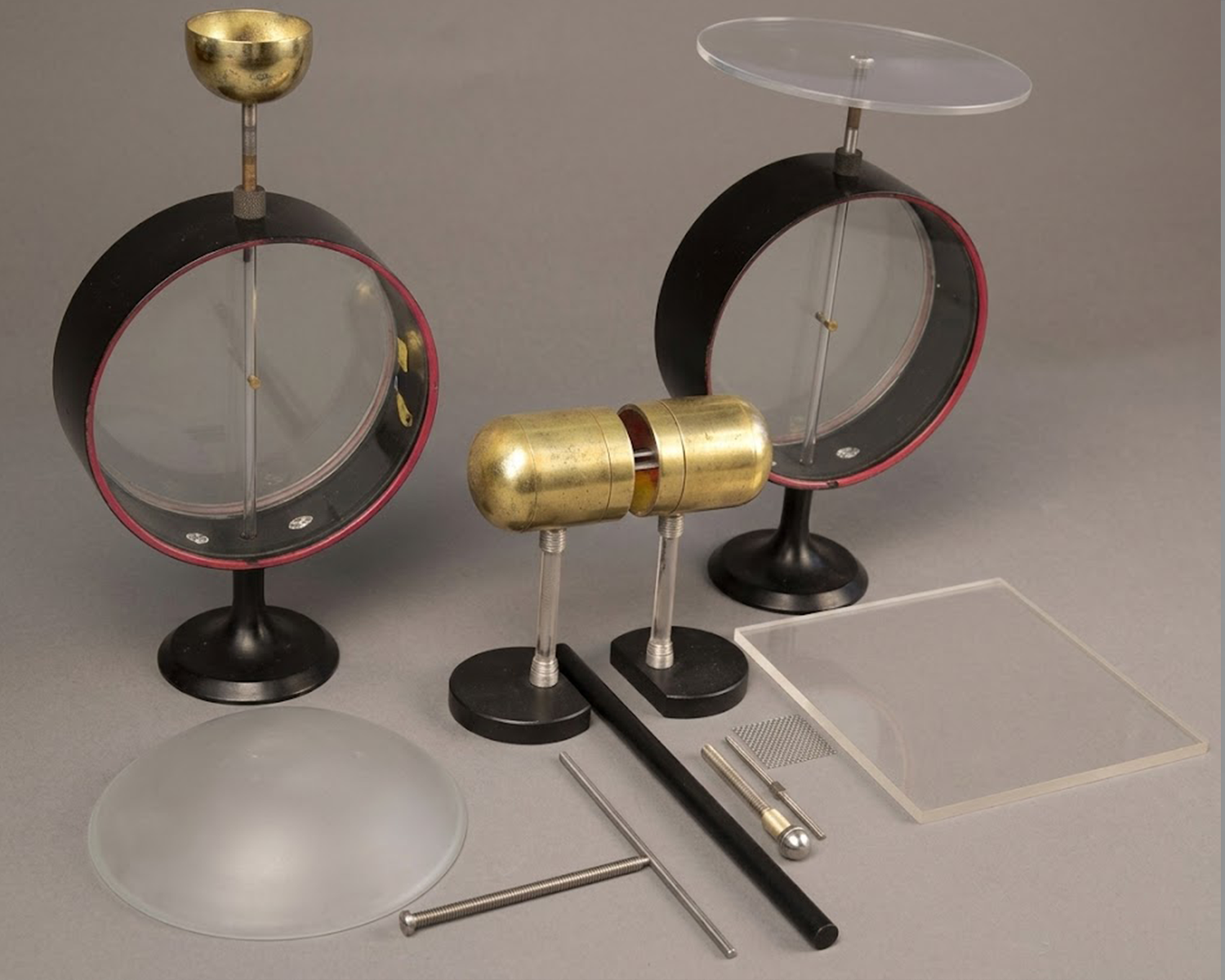
A set of demonstration electrostatics apparatus for school physics classrooms, used by the teacher to show charge distribution on a conductor, charge leakage from a point, the action of an electric field on light bodies and charge transfer between conductors. Charge is fed to the components from an external high-voltage source such as a Wimshurst machine.

Thank you! Your submission has been received!
Oops! Something went wrong while submitting the form.

Specification

icon plus
  • Purpose: demonstration experiments in electrostatics — charge distribution over a conductor surface, charge leakage from a point, action of an electric field on light bodies, and charge transfer between conductors
  • Number of components: 9
  • Power supply: none required; charge is fed from an external high-voltage source (Wimshurst machine, electrophorus or similar) through the connecting leads and chains
  • Mounting: electrodes are built on their own bases for placement on a demonstration table

Kit Contents:

Electrodes and Conductors
  • Conductor sphere, diameter 50 mm — 1 pc
  • Spherical electrode, 90 × 90 × 260 mm, sphere diameter 90 mm — 1 pc
  • Needle electrode, 100 × 88 × 220 mm, diameter 50 mm — 1 pc
  • Metal chains — 2 pcs
Indicators and Test Bodies
  • Bundle of paper strips on a rod — 1 pc
  • Neon lamp on a rubber stopper — 1 pc
  • Electric bells, 130 × 88 × 200 mm — 1 pc
Connections
  • Set of connecting leads, crocodile clips at both ends — 1 pc

Product passport: ULABS-P094 (PDF)

Additional info

icon plus

Operation

  • Check the kit against the contents list after unpacking; the spherical surface should be smooth and free of dents and burrs, the needle point sharp and not bent, and the insulating stands clean and dry.
  • Place the electrodes on a dry horizontal demonstration table, far enough apart to prevent spontaneous discharge and visible from the observation seats; keep the high-voltage source to one side, outside the reach of accidental contact.
  • Wipe all metal surfaces and insulating stands with a dry lint-free cloth — dust and damp film create charge leakage paths and the experiments stop working.
  • Connect the lead clips to the source terminals and to the electrodes only while the source is stopped; keep the leads off the floor and away from stray metal objects.

Demonstrations

  • Charge distribution over a conductor: charge the conductor sphere or the spherical electrode and probe different areas of the surface with a test conductor connected to a charge indicator.
  • Charge leakage from a point: feed charge to the needle electrode — an electric wind forms near the tip, deflecting the bundle of paper strips, and a faint glow at the tip is visible in a darkened room.
  • Field action on light bodies: connect the bundle of paper strips on the rod to the source; the strips take a like charge and spread apart, falling back once the charge is removed.
  • Charge transfer: place the electric bells between a charged electrode and an earthed conductor — the pendulum swings between the cups, carrying charge in portions.
  • High-voltage indication: connect the neon lamp on the rubber stopper to charged conductors with the clips; it flashes as the charge passes. Hold the lamp only by the rubber stopper.

Safety

  • Connect and disconnect leads, chains and electrodes only with the high-voltage source stopped and discharged.
  • After every experiment remove the charge from the electrodes, sphere, leads and chains by connecting them to an earthed conductor — charge remains after the source is stopped.
  • Clear mobile phones, laptops, sensors and other electronic devices from the demonstration table: a spark discharge destroys them.
  • People with implanted pacemakers and other electronic medical devices must not work with the product.
  • Do not run experiments near alcohol, ether or other flammable substances, or near loose paper strips that are not fixed to the rod — a discharge from the point ignites them.
  • The demonstration is performed by the teacher only; other people stay at a safe distance from the electrodes and leads.
  • Recommended for learners aged 10 and older (grade 5 and up), under the supervision of a teacher.

Operating and Storage Conditions

  • Air temperature: +5 °C to +40 °C
  • Relative humidity: 40 % to 60 %
  • Atmospheric pressure: 84 to 107 kPa (630-800 mm Hg)
  • Store in a dry, clean, ventilated room at +5 °C to +40 °C and relative humidity of 60 %, protected from direct sunlight, moisture, dust and heat sources; keep the air free of impurities that corrode metals.

Maintenance

  • Wipe the metal electrodes, sphere, chains and clips with a dry soft lint-free cloth; clean the insulating stands and the rubber stopper with a cloth dampened in water with a neutral agent, then dry them completely. Do not use abrasives — scratches and burrs on the electrodes cause premature discharge.
  • Periodically check the condition of the needle tip, the integrity of the lead insulation, the springs of the crocodile clips and the free movement of the electric bells pendulum. Replace any lead with damaged insulation.
  • Put the kit away discharged and laid out in the packaging slots, in a dry heated room; keep the chains straightened and the paper strips combed out so they do not stick together.

Warranty and Disposal

  • Warranty: 3 years, covering defect elimination and replacement of defective parts or equipment; spare parts and consumables available for 5 years.
  • Disposal: the product is not electrical or electronic equipment and carries no WEEE marking; it contains no hazardous substances and is disposed of as municipal waste after separation by material.

icon plus
How long is the MIKKO Course?
Is the MIKKO Course good for new teachers
How long is the MIKKO Course?
Ask something?
More information

More information

Related products
view all

What our clients are saying about us.
view all

Customer testimonials

What our clients are saying about us.

Working with UNOWA was a turning point for our university. Their expert-led training in ABA, ADOS-2 and MIKKO reshaped how we think, teach, and prepare inclusive educators. The model inclusion classroom they equipped has become a living lab, a space where theory becomes hands-on skill. This partnership didn’t just support a project. It laid the foundation for a more humane, modern and inclusive education system in Kazakhstan.
Yerkin Zhumankulova
Vice-Rector in Academic Affairs. Kazakh National Women's Teacher Training University
Thanks to UNOWA’s innovative approach and professional guidance, we’ve redefined how we prepare future educators. The MIKKO training and inclusion lab brought international best practices to our university, not just as theory, but as living, hands-on tools that inspire confidence and real change.
Irina Rovnyakova
Vice-Rector for Strategic Development and International Relations. Sarsen Amanzholov East Kazakhstan University
Working with the UNOWA team was a valuable and supportive experience in delivering psychological and educational projects. Their reliable platform, openness to dialogue, and continuous technical support allowed me to focus on the quality and meaning of education. I confidently recommend UNOWA as a trusted partner for the development of psychological education and human-centered support.
Liudmyla Lahuta
President of the International Institute of Psychological Maturity INC
Thanks to our partnership with UNOWA, even schools in Armenia’s most remote regions now have access to fully equipped science and technology labs. Nearly half of the country’s schools have been modernized, bringing equal learning conditions to every student, no matter where they live.
Zhanna Andreasyan
Minister of Education, Science, Culture and Sport. The Government of the Republic of Armenia
UNOWA's national project equipped 14 Kazakhstan universities with inclusive classrooms to a unified standard. They delivered top-quality kits, equipment, digital courses with 24/7 access, and localized resources. This game-changer strengthened inclusive education foundations nationwide.
Dastan Yessenov
Coordinator of the PIU of World Bank in the Republic of Kazakhstan
UNOWA's national-level ABA and ADOS-2 training became a milestone for Kazakhstan's education system. The program was comprehensive, well-structured, and perfectly aligned with inclusive education modernization goals nationwide. I appreciated the balance of deep theory, practical sessions, and 24/7 online access. This strengthened specialists' ABA and diagnostics skills, directly improving support for children with special needs.
Karlygash Zholdassova
Inclusion Education Specialist of PIU of World Bank in the Republic of Kazakhstan
icon arrow left
icon arrow right

Customer testimonials

What our clients are saying about us.

UNOWA's national project equipped 14 Kazakhstan universities with inclusive classrooms to a unified standard. They delivered top-quality kits, equipment, digital courses with 24/7 access, and localized resources. This game-changer strengthened inclusive education foundations nationwide.
Dastan Yessenov
Coordinator of the PIU of World Bank in the Republic of Kazakhstan
UNOWA's national-level ABA and ADOS-2 training became a milestone for Kazakhstan's education system. The program was comprehensive, well-structured, and perfectly aligned with inclusive education modernization goals nationwide. I appreciated the balance of deep theory, practical sessions, and 24/7 online access. This strengthened specialists' ABA and diagnostics skills, directly improving support for children with special needs.
Karlygash Zholdassova
Inclusion Education Specialist of PIU of World Bank in the Republic of Kazakhstan
Working with the UNOWA team was a valuable and supportive experience in delivering psychological and educational projects. Their reliable platform, openness to dialogue, and continuous technical support allowed me to focus on the quality and meaning of education. I confidently recommend UNOWA as a trusted partner for the development of psychological education and human-centered support.
Liudmyla Lahuta
President of the International Institute of Psychological Maturity INC
Thanks to our partnership with UNOWA, even schools in Armenia’s most remote regions now have access to fully equipped science and technology labs. Nearly half of the country’s schools have been modernized, bringing equal learning conditions to every student, no matter where they live.
Zhanna Andreasyan
Minister of Education, Science, Culture and Sport. The Government of the Republic of Armenia
Thanks to UNOWA’s innovative approach and professional guidance, we’ve redefined how we prepare future educators. The MIKKO training and inclusion lab brought international best practices to our university, not just as theory, but as living, hands-on tools that inspire confidence and real change.
Irina Rovnyakova
Vice-Rector for Strategic Development and International Relations Sarsen Amanzholov East Kazakhstan University
Working with UNOWA was a turning point for our university. Their expert-led training in ABA, ADOS-2 and MIKKO reshaped how we think, teach, and prepare inclusive educators. The model inclusion classroom they equipped has become a living lab, a space where theory becomes hands-on skill. This partnership didn’t just support a project. It laid the foundation for a more humane, modern and inclusive education system in Kazakhstan.
Yerkin Zhumankulova
Vice-Rector in Academic Affairs Kazakh National Women's Teacher Training University
icon arrow left
icon arrow right
Demonstration Electrostatics Set
Speak to expertimage of finger pointing to a graph