Cup anemometer

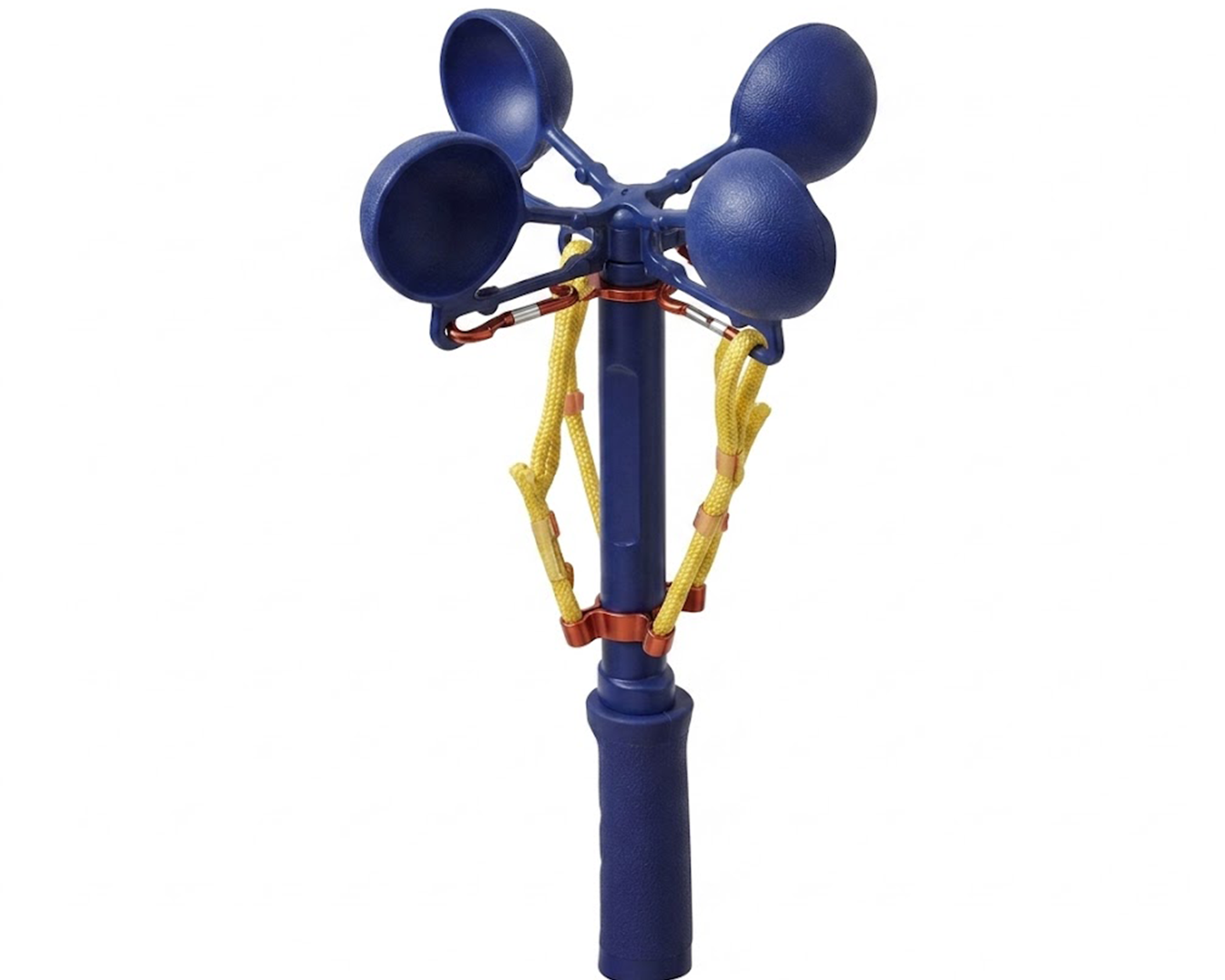
A cup anemometer for weather observation in geography and science lessons: hemispherical cups mounted crosswise on a vertical axis are turned by the wind, and the display shows instantaneous and average wind speed, wind force in points and the corresponding wave height. Intended for K-12 learners aged 10 and over working under the supervision of a teacher.

Thank you! Your submission has been received!
Oops! Something went wrong while submitting the form.

Specification

icon plus
  • Purpose: measurement of wind speed and weather observation in science and mathematics classrooms
  • Sensor type: cup type, hemispherical cups mounted crosswise on a vertical axis
  • Operating principle: the airflow presses on the concave and convex sides of the cups with different force, so the rotor turns at a rate proportional to the wind speed
  • Wind speed measuring range: 0.5 to 30 m/s
  • Sensor start-up speed (lower limit of the range): 0.5 m/s
  • Wind speed measurement error: +/-(0.3 + 0.03 x V) m/s, where V is the actual speed
  • Resolution: 0.1 m/s; 1 point; 0.1 m
  • Displayed values: instantaneous and average wind speed, instantaneous and average wind force in points, corresponding wave height
  • Readout: display
  • Operating temperature: -45 to +60 °C
  • Relative humidity: 100 %, non-condensing
  • Average current consumption: 5 mA
  • Power supply: self-contained battery power
  • Marking: CE and WEEE

Product passport: ULABS-G013 (PDF)

Additional info

icon plus
Preparation and installation
  • Inspect the rotor: all cups intact, of the same shape, free of dents and cracks and firmly fixed on the traverses. A damaged or deformed cup changes the aerodynamics of the rotor and falsifies the readings.
  • Check the free run: spin the rotor lightly by hand and release it. A sound rotor makes several turns by inertia and stops smoothly; binding, squeaking or an abrupt stop indicates contaminated or worn bearings.
  • Switch the instrument on and check that all displayed values appear in full. Dim or vanishing indication means the battery has to be replaced before going out to the observation site.
  • Mount the anemometer with the axis strictly vertical on a mast or a tripod, or hold it in an outstretched hand above the head. A tilted axis lowers the readings.
  • Choose an open site. Buildings, fences, trees and the observer create turbulence and a wind shadow; pass obstacles at a distance noticeably greater than their height. For comparable observations, install the instrument at the same height and at the same point every time.
Measurement procedure
  • Hold the instrument in the working position until the rotor reaches a steady rate of rotation: in the first seconds after installation the readings are low because of rotor inertia.
  • Instantaneous wind speed changes continuously, so the wind is characterised by the average speed over the observation period, while the instantaneous value is recorded separately as a measure of gusts.
  • Wind force is shown in points with a resolution of 1 point and wave height with a resolution of 0.1 m. Wave height is a calculated value corresponding to the measured wind force on open water; on land it is a reference figure.
  • Record the date, time, place and installation height together with the result; without these data the readings are not comparable.
  • Wind speed below 0.5 m/s is not measured: the rotor does not turn in such a flow and the condition is recorded as calm. Readings taken immediately after spinning the rotor by hand are not used.
  • Daily characteristics are obtained by observing at fixed hours, in the same sequence of actions and with the same averaging time.
Factors affecting the result
  • The error consists of a constant component of 0.3 m/s and a component proportional to the speed, a further 3 % of the measured value.
  • Rotor inertia smooths out gusts: in rapidly changing wind the instantaneous readings lag behind and stay high for some time after a strong gust. Only an averaged value gives a reliable characteristic.
  • A tilted axis, installation at low height, nearby obstacles and an observer standing on the windward side systematically lower the readings.
  • Contaminated bearings and dust, moisture or hoarfrost on the cups raise the speed at which the rotor starts to turn, and the instrument stops responding to light wind.
  • Operation outside the range of -45 to +60 °C and condensation inside the housing at humidity close to 100 % cause indication faults. An instrument brought in from the cold is kept indoors until the condensation disappears.
Safety
  • Use batteries only of the type and rating stated in the product documentation or on the housing; do not mix new and partly discharged cells and observe the polarity.
  • If signs of electrolyte leakage appear, remove the cells immediately without touching the contents. Remove the batteries if the instrument will not be used for more than a month.
  • Do not recharge cells that are not intended for recharging and do not throw them into fire.
  • Do not open the housing and do not expose the instrument to impact, moisture or direct sunlight.
  • Do not stop the rotor with your hand and do not brake the cups while they turn: this damages the axis and the bearings.
  • Do not take measurements during a thunderstorm and do not mount the instrument on a mast in a thunderstorm or in icy conditions. Fasten it securely on its support.
  • Do not lubricate the rotor axis and bearings: lubricant collects dust and raises the speed at which the sensor starts to work.
  • Learners work with the instrument under the supervision of a teacher.
Maintenance
  • After each observation cycle clean the cups and traverses of dust, dirt and salts with a soft damp cloth and dry the rotor. Do not wash the instrument with a pressurised water jet.
  • Periodically check the tightness of the cups on the traverses and of the traverses on the axis, and check the rotor run-out. A rotor that stops almost at once needs its bearings cleaned; dented cups are replaced as a complete set.
  • Watch the condition of the battery and replace it in good time before a series of observations; remove it before a long break in operation.
  • After observations remove the anemometer from its support and keep it in a dry room where the rotor is protected from impact. Do not stand the instrument on its rotor and do not place objects on it.
Storage, transport and disposal
  • Store in a dry, clean, ventilated room at +5 °C to +40 °C and relative humidity of 60 %, non-condensing, protected from direct sunlight, moisture, dust and heat sources. Keep the storage air free of impurities that cause corrosion of metals.
  • Operating climatic conditions: air temperature +5 °C to +40 °C, relative humidity 40 % to 60 %, atmospheric pressure 84 to 107 kPa (630-800 mmHg).
  • During transport the packed product is secured against movement and protected from precipitation and impact; the product is supplied in the manufacturer's packaging.
  • The product carries the WEEE marking and is not disposed of with unsorted household waste. Remove the batteries before disposal and hand them in separately; metal parts are recycled as scrap metal and electronic components go to specialised recycling.
Warranty
  • Warranty obligations cover the elimination of defects and the replacement of defective parts or of the equipment for three years, and the availability of spare parts and consumables for five years.

icon plus
How long is the MIKKO Course?
Is the MIKKO Course good for new teachers
How long is the MIKKO Course?
Ask something?
More information

More information

Related products
view all

What our clients are saying about us.

view all

Customer testimonials

What our clients are saying about us.

Working with UNOWA was a turning point for our university. Their expert-led training in ABA, ADOS-2 and MIKKO reshaped how we think, teach, and prepare inclusive educators. The model inclusion classroom they equipped has become a living lab, a space where theory becomes hands-on skill. This partnership didn’t just support a project. It laid the foundation for a more humane, modern and inclusive education system in Kazakhstan.
Yerkin Zhumankulova
Vice-Rector in Academic Affairs. Kazakh National Women's Teacher Training University
Thanks to UNOWA’s innovative approach and professional guidance, we’ve redefined how we prepare future educators. The MIKKO training and inclusion lab brought international best practices to our university, not just as theory, but as living, hands-on tools that inspire confidence and real change.
Irina Rovnyakova
Vice-Rector for Strategic Development and International Relations. Sarsen Amanzholov East Kazakhstan University
Working with the UNOWA team was a valuable and supportive experience in delivering psychological and educational projects. Their reliable platform, openness to dialogue, and continuous technical support allowed me to focus on the quality and meaning of education. I confidently recommend UNOWA as a trusted partner for the development of psychological education and human-centered support.
Liudmyla Lahuta
President of the International Institute of Psychological Maturity INC
Thanks to our partnership with UNOWA, even schools in Armenia’s most remote regions now have access to fully equipped science and technology labs. Nearly half of the country’s schools have been modernized, bringing equal learning conditions to every student, no matter where they live.
Zhanna Andreasyan
Minister of Education, Science, Culture and Sport. The Government of the Republic of Armenia
UNOWA's national project equipped 14 Kazakhstan universities with inclusive classrooms to a unified standard. They delivered top-quality kits, equipment, digital courses with 24/7 access, and localized resources. This game-changer strengthened inclusive education foundations nationwide.
Dastan Yessenov
Coordinator of the PIU of World Bank in the Republic of Kazakhstan
UNOWA's national-level ABA and ADOS-2 training became a milestone for Kazakhstan's education system. The program was comprehensive, well-structured, and perfectly aligned with inclusive education modernization goals nationwide. I appreciated the balance of deep theory, practical sessions, and 24/7 online access. This strengthened specialists' ABA and diagnostics skills, directly improving support for children with special needs.
Karlygash Zholdassova
Inclusion Education Specialist of PIU of World Bank in the Republic of Kazakhstan
icon arrow left
icon arrow right

Customer testimonials

What our clients are saying about us.

UNOWA's national project equipped 14 Kazakhstan universities with inclusive classrooms to a unified standard. They delivered top-quality kits, equipment, digital courses with 24/7 access, and localized resources. This game-changer strengthened inclusive education foundations nationwide.
Dastan Yessenov
Coordinator of the PIU of World Bank in the Republic of Kazakhstan
UNOWA's national-level ABA and ADOS-2 training became a milestone for Kazakhstan's education system. The program was comprehensive, well-structured, and perfectly aligned with inclusive education modernization goals nationwide. I appreciated the balance of deep theory, practical sessions, and 24/7 online access. This strengthened specialists' ABA and diagnostics skills, directly improving support for children with special needs.
Karlygash Zholdassova
Inclusion Education Specialist of PIU of World Bank in the Republic of Kazakhstan
Working with the UNOWA team was a valuable and supportive experience in delivering psychological and educational projects. Their reliable platform, openness to dialogue, and continuous technical support allowed me to focus on the quality and meaning of education. I confidently recommend UNOWA as a trusted partner for the development of psychological education and human-centered support.
Liudmyla Lahuta
President of the International Institute of Psychological Maturity INC
Thanks to our partnership with UNOWA, even schools in Armenia’s most remote regions now have access to fully equipped science and technology labs. Nearly half of the country’s schools have been modernized, bringing equal learning conditions to every student, no matter where they live.
Zhanna Andreasyan
Minister of Education, Science, Culture and Sport. The Government of the Republic of Armenia
Thanks to UNOWA’s innovative approach and professional guidance, we’ve redefined how we prepare future educators. The MIKKO training and inclusion lab brought international best practices to our university, not just as theory, but as living, hands-on tools that inspire confidence and real change.
Irina Rovnyakova
Vice-Rector for Strategic Development and International Relations Sarsen Amanzholov East Kazakhstan University
Working with UNOWA was a turning point for our university. Their expert-led training in ABA, ADOS-2 and MIKKO reshaped how we think, teach, and prepare inclusive educators. The model inclusion classroom they equipped has become a living lab, a space where theory becomes hands-on skill. This partnership didn’t just support a project. It laid the foundation for a more humane, modern and inclusive education system in Kazakhstan.
Yerkin Zhumankulova
Vice-Rector in Academic Affairs Kazakh National Women's Teacher Training University
icon arrow left
icon arrow right
Cup anemometer
Speak to expertimage of finger pointing to a graph